| HS Code | 942974 |
| Density | 1.18 g/cm³ |
| Melt Flow Rate | 24 g/10 min (230°C, 3.8 kg) |
| Tensile Strength | 45 MPa |
| Tensile Elongation At Break | 15% |
| Flexural Strength | 70 MPa |
| Flexural Modulus | 2300 MPa |
| Izod Impact Notched 23c | 220 J/m |
| Izod Impact Notched 30c | 80 J/m |
| Heat Deflection Temperature 1 82mpa | 75 °C |
| Vicat Softening Temperature | 90 °C |
| Flammability Rating Ul94 | V-0 at 1.5 mm |
| Oxygen Index | 35% |
| Volume Resistivity | 1E16 ohm·cm |
| Mold Shrinkage | 0.5-0.7% |
As an accredited Acrylonitrile‑Butadiene‑Styrene Resin FR-771 factory, we enforce strict quality protocols—every batch undergoes rigorous testing to ensure consistent efficacy and safety standards.
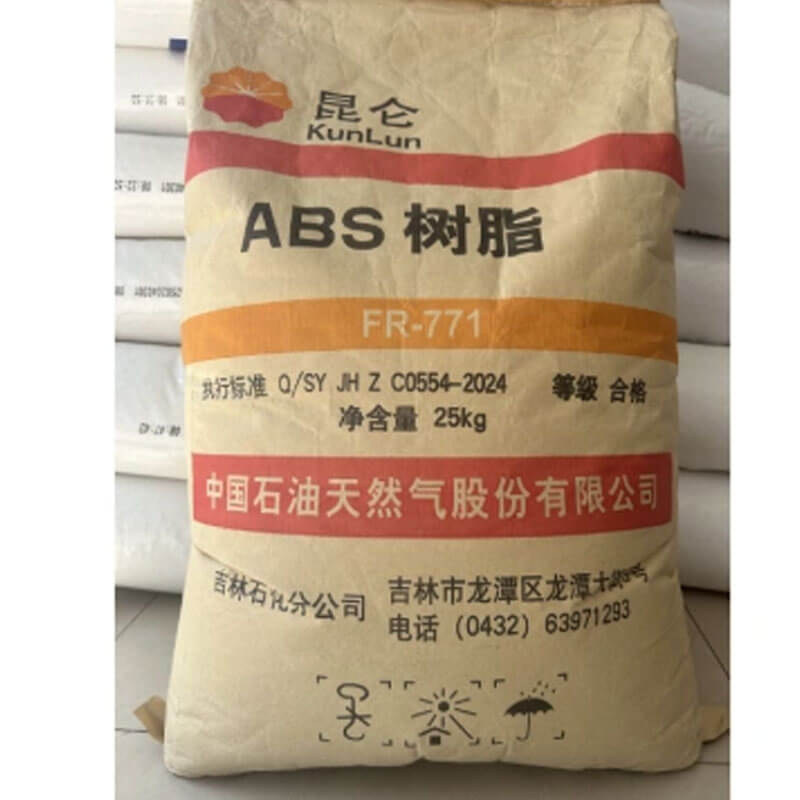
| Packing | Acrylonitrile-Butadiene-Styrene Resin FR-771 is packaged in 25 kg multi-layer paper bags, heat-sealed to ensure moisture protection. |
| Container Loading (20′ FCL) | Acrylonitrile-Butadiene-Styrene Resin FR-771 in 20' FCL, packed in 25kg bags on pallets, stowed securely. |
| Shipping | Acrylonitrile-Butadiene-Styrene Resin FR-771 is a non-hazardous plastic resin. Ship as non-dangerous cargo, not regulated under IMO/ADR. Use sealed bags or drums to prevent dust dispersion. Avoid moisture and extreme heat. No special handling required, but standard safe loading practices apply. |
| Storage | Store Acrylonitrile-Butadiene-Styrene Resin FR-771 in a cool, dry, well-ventilated area away from ignition sources and direct sunlight. Keep containers tightly sealed to prevent moisture contamination and dust accumulation. Avoid exposure to high temperatures and oxidizers. Ensure proper labeling and compliance with local regulations. |
| Shelf Life | Shelf life is typically two years when stored in original, unopened containers under dry, cool conditions away from sunlight. |
Low-voltage switchgear enclosures moulded from FR-771 require a documented pre-drying step before the melt enters the barrel. Residual moisture above 0.05 wt% is sufficient to produce splay marks on the exterior wall at flow distances beyond 120 mm, especially when the tool surface is polished to a high gloss. When the desiccant hopper dew point rises above −30 °C, batch rejection rates increase because volatilized moisture tears the flow front at knit lines near the DIN rail mounting bosses. The barrel profile is set from rear 190–210 °C, centre 200–220 °C, front 210–230 °C, nozzle 210–230 °C, with melt temperature measured at the nozzle tip not exceeding 240 °C. Prolonged residence above 240 °C accelerates release of brominated flame-retardant degradation species that deposit on the check ring and vent stack, reducing shot-to-shot cushion consistency after 48–72 h of continuous operation. Mould temperature is held at 50–70 °C to balance surface appearance against cycle time; below 40 °C weld-line strength at the latch bosses can fall below the level required to pass a 1.0 m drop test after assembly. Injection speed is set in the range 30–80 mm/s, with pack pressure 60–80 MPa for a screw diameter of 35 mm, and hold time is keyed to gate freeze-off as measured by part weight stabilisation rather than fixed timer settings. On moulds with cold runner diameters below 3.0 mm, the flame-retardant melt can produce pressure spikes above 120 MPa, which overpack thin ribs and cause post-mould warpage of the rear panel. The exact flame-retardant package of FR-771 should be confirmed against the supplier safety data sheet before any metal soap mould-release agent is introduced, because incompatible release chemistry can destabilise the additive system and alter UL 94 V-0 performance at 1.6 mm.
Flame-retardant ABS regrind is not a direct like-for-like substitution because the halogenated flame-retardant package and antimony trioxide synergist undergo partial degradation during first-pass moulding. When FR-771 sprues and runners are ground and re-compounded at 20 wt%, the notched Charpy impact strength measured under ISO 179-1/1eA at 23 °C typically shifts toward the lower end of the unfilled flame-retardant ABS distribution, often falling between 8 kJ/m² and 14 kJ/m². At 30 wt% regrind content, weld-line toughness in boss-rich parts decreases to a point where ultrasonic insertion of brass inserts can crack the boss in more than 5% of samples, depending on insert diameter and hole diameter tolerance. The controlling variable is not only molecular weight reduction but also dispersion of the oxidized flame-retardant phase: reground material exposed to melt temperatures above 235 °C for more than 12 min cumulative residence time shows higher plate-out on mould vents under ASTM D6289 visual contamination testing. For IEC 62368-1 audio/video and information technology equipment enclosures, the mechanical strength requirement is derived from the end-product drop and impact test, not from a minimum resin impact specification, so validated regrind ratio must be confirmed on the actual part geometry. Published data for FR-771 at regrind levels above 40 wt% in thin-wall enclosures is limited; qualification trials should include a minimum of 50 consecutive moulding cycles with regrind to stabilise the melt flow rate under ISO 1133-1:2022 and monitor gate blush.
In hot-runner conversion of FR-771 for power adapter shells, the thermal mass of the manifold creates a conflict between the low melt temperature needed to protect the flame-retardant package and the high melt temperature needed to flow through restricted gates. Valve-gated systems with nozzle orifice diameters of 0.8–1.2 mm require melt temperatures at the nozzle tip of 225–240 °C; below 220 °C the pressure drop across the valve pin exceeds the machine capability of many all-electric presses in the 80–100 t clamp class. The resulting fill time increases beyond 0.8 s, producing premature freeze-off in the gate area and short shots at the snap-fit features. Where 1.0 mm walls must pass UL 94 V-0 at 1.0 mm, the mould temperature is raised to 60–80 °C to delay skin solidification and permit uniform packing of the living hinge and latch ribs. Higher mould temperatures shorten the available ejection window because heat deflection temperature under ISO 75-2:2013 method A is in the range of 80–95 °C for typical unfilled flame-retardant ABS, and parts ejected above 85 °C show visible deformation at the gate pad. Thermal imaging of the tool after 20 consecutive cycles is used to identify zones above 90 °C that correspond to post-ejection shrink differences of more than 0.3 mm across a 150 mm length. Amine-based antistatic masterbatches are not compatible with the halogenated flame-retardant system; evaluation trials using tertiary amine antistats have produced plate-out and a loss of UL 94 V-0 at 1.0 mm.
Outdoor EV charging coupler housings introduce an additional constraint: the part must maintain dimensional stability after 1,000 h of damp heat cycling at 85 °C/85% RH while retaining the flame-retardant rating after environmental exposure. FR-771 is evaluated for these enclosures only when the part is shielded from direct UV by a cover or pigmented with carbon black; unpigmented natural resin should not be used outdoors because ABS undergoes photodegradation and embrittlement. The critical test sequence is UL 94 V-0 after conditioning under IEC 60068-2-78, because some brominated flame-retardant systems show surface blooming that alters ignition resistance. Moulded terminals and snap-fit rings must be stress-relieved by annealing at 65 ± 2 °C for 2 h, because residual moulding stress above 4 MPa can drive stress cracking when the housing is exposed to lithium grease or dielectric grease during assembly. Wall stock below 2.0 mm is generally avoided due to low-temperature impact concerns: at −20 °C the notched Izod impact value under ISO 180/A for this grade class may fall below 6 kJ/m², and published data for FR-771 at −40 °C is limited.
Extruded FR-771 sheet enters kiosk and medical cart equipment covers where a Class B or Class A surface is required after matte or hairline embossing. Sheet extrusion of flame-retardant ABS requires a drying target below 0.02 wt% moisture because residual moisture causes micro-voids that appear as pinholes after the sheet is drawn to a depth ratio of 1.5:1. The extruder is typically a single-screw with L/D 30:1 and a barrier screw, with die temperature 210–230 °C and roll stack temperatures of 80–100 °C on the top roll, 85–105 °C on the middle roll, and 50–70 °C on the cooling roll. Sheet thickness is controlled to ±0.05 mm, because thinning at corners of a formed enclosure directly shifts the effective UL rating: a nominal 3.0 mm sheet that thins below 1.2 mm at the draw corners may no longer meet UL 94 V-0 at the rated thickness unless the test specimen is cut from the formed corner. Thermoforming is performed with a surface temperature of 150–170 °C; above 180 °C the brominated additive contributes to surface gloss change and possible blistering. The sheet should be heated uniformly to avoid differential sag above 15 mm over a 500 mm span, which causes non-uniform wall distribution and web thinning at the clamping edge.
FR-771 is specified for low-voltage connector insulators and terminal blocks where compact creepage distances are constrained by board pitch. The comparative tracking index measured under IEC 60112 is typically in the range of 250–400 V for unfilled flame-retardant ABS, meaning the material falls into material group IIIa or IIIb of IEC 60664-1 depending on lot-to-lot filler content. This classification directly affects minimum creepage distance: for a working voltage of 250 V, pollution degree 2, and material group IIIb, the required creepage may be larger than for a material group II plastic, which can force a redesign of terminal pitch from 5.0 mm to 7.5 mm. Antimony trioxide and other flame-retardant synergist particles in the surface layer can create conductive tracking paths under condensation, so the use of a 50 mm × 50 mm plaque conditioned under IEC 60068-2-30 variant 2 is recommended before lot acceptance. In high-humidity environments above 85% RH, surface resistivity under ASTM D257 may fall below 10¹³ Ω/sq, which is unacceptable for circuits with close conductor spacing unless conformal coating is applied.
| Verification parameter | Standard or test method | Condition | Typical acceptance range |
|---|---|---|---|
| Vertical flammability | UL 94 | 1.0 mm and 1.6 mm specimen | V-0, no flaming after 10 s per application |
| Glow wire ignition temperature | IEC 60695-2-11 | 850 °C / 30 s | flame extinguishes within 30 s; no ignition of tissue |
| Comparative tracking index | IEC 60112 | Solution A, 50 drops | ≥ 250 V |
| Residual moisture before moulding | ASTM D6869 or Karl Fischer | desiccant drier outlet | ≤ 0.05 wt% |
| Melt flow rate stability | ISO 1133-1:2022 | 220 °C / 10 kg | within ± 3 g/10 min of lot certificate |
| Notched Izod impact | ISO 180/A | 23 °C | ≥ 8 kJ/m² |
A further production line uses FR-771 for under-dash HVAC actuator housings accepted only when the part passes FMVSS 302 horizontal burn rate of ≤ 100 mm/min for the thinnest section, which is often the gear cover wall at 1.0 mm. In this application the resin is selected when the housing must maintain screw boss torque retention above 1.2 N·m after heat ageing at 85 °C for 500 h. The mould design uses vent depths of 0.02–0.03 mm because venting beyond 0.05 mm leads to flash in the flame-retardant grade at packing pressures above 50 MPa. A critical process limit is cooling time: because the material has a Vicat softening temperature near 95–105 °C under ISO 306:2022, ejection at a part surface temperature above 90 °C can distort the gear mounting plane beyond 0.1 mm flatness.
Competitive Acrylonitrile‑Butadiene‑Styrene Resin FR-771 prices that fit your budget—flexible terms and customized quotes for every order.
For samples, pricing, or more information, please contact us at +8618136850665 or mail to sales4@ascent-chem.com.
We will respond to you as soon as possible.
Tel: +8618136850665
Email: sales4@ascent-chem.com
Flexible payment, competitive price, premium service - Inquire now!
Acrylonitrile-Butadiene-Styrene Resin FR-771 is a brominated flame-retardant ABS grade supplied as cylindrical pellets for injection molding and for limited thin-wall extrusion. The grade is part of the FR-77x family in which the active flame-retardant package combines a brominated aromatic component with antimony trioxide synergist, producing condensed-phase charring and vapour-phase radical scavenging after ignition. Component designers typically specify FR-771 for electrical enclosures, power supply housings, and appliance control boxes that require a UL 94 V-0 classification at wall thicknesses shown on the product Yellow Card and for which a general-purpose ABS cannot meet the same thickness-limited flammability requirement. Because the producer’s certificate of analysis controls lot-specific values and the Yellow Card may restrict colour, regrind ratio, and minimum thickness, processing trials should use the exact production colour and the intended regrind fraction. Where published third-party data for this exact designation is limited, the property window for equivalent unfilled halogenated V-0 ABS grades is used below with the relevant test method designations.
Before FR-771 enters the hopper, moisture removal is mandatory when ambient relative humidity exceeds 60 %. A desiccant dryer with a dew point of -30 °C or lower is operated at 80 °C for 4 h to reduce pellet moisture below 0.05 %. Insufficient drying produces silver streaks and reduces flame-retardant performance at the same wall thickness because hydrolysis products of the brominated package accelerate degradation of the SAN continuous phase.
On production injection moulding lines, a barrel temperature profile from rear to nozzle is established between 180 °C and 230 °C, with melt temperature measured by a pyrometer held at 210–240 °C. The mould surface is maintained at 40–80 °C; higher settings improve knit-line strength but extend cycle time by 5–15 %. Back pressure is set at 3–10 bar hydraulic, and screw speed is limited to 30–80 min⁻¹ to prevent shear heating. The screw should have an L/D ratio between 20:1 and 25:1 and a compression ratio between 2.2:1 and 2.8:1. Shot size should be maintained between 30 % and 75 % of barrel capacity. Residence time above 300 s at melt temperatures above 240 °C is not recommended because the brominated flame retardant releases hydrogen halide degradation products, causing yellowing, surface blush, and accelerated corrosion of nitrided screw and barrel surfaces.
Capillary rheometry at 230 °C for comparable unfilled FR ABS grades shows apparent viscosity in the range 120–400 Pa·s at apparent shear rates of 100–1,000 s⁻¹, with pronounced shear thinning. Mould filling simulations should use cross-WLF parameters fitted to three-temperature viscosity sweeps rather than a single MVR value. Melt volume-flow rate measured under ISO 1133-1:2022 at 220 °C/10 kg typically falls between 18 cm³/10 min and 28 cm³/10 min for FR-771 lots used in thin-wall enclosure tooling.
The flame-retardant package also imposes chemical constraints. The grade should not be blended with amine-based HALS stabilisers or carbodiimide chain extenders, because amine functional groups can scavenge the acidic intermediates required for the antimony–bromine flame-retardant mechanism and reduce the UL 94 margin at 1.5 mm. Regrind should be limited to 25 % unless the specific Yellow Card indicates a higher allowable fraction. Reground material that has passed through a hot-runner system with dead spots may contain pre-degraded polymer and should be re-qualified by a UL 94 vertical burn test, ISO 179-1/1eA impact testing, and a melt flow check before release to production.
The property values reported below are not a certificate of analysis but represent the typical range for unfilled brominated V-0 ABS grades of the FR-771 class. Lot-specific values must be obtained from the producer’s technical data sheet and overrule these ranges for tool design.
| Property | Method | Typical Range |
|---|---|---|
| Density | ISO 1183-1:2019 | 1.17–1.20 g/cm³ |
| Melt volume-flow rate, 220 °C/10 kg | ISO 1133-1:2022 | 18–28 cm³/10 min |
| Tensile stress at yield | ISO 527-2/1A/50 | 38–45 MPa |
| Tensile elongation at yield | ISO 527-2/1A/50 | 5–12 % |
| Flexural modulus | ISO 178 | 2,200–2,600 MPa |
| Flexural strength | ISO 178 | 58–68 MPa |
| Charpy notched impact strength, 23 °C | ISO 179-1/1eA | 8–18 kJ/m² |
| Izod notched impact strength, 23 °C | ISO 180/A | 12–20 kJ/m² |
| Heat deflection temperature, 1.8 MPa | ISO 75-2/B | 78–88 °C |
| Vicat softening temperature, B50 | ISO 306/B50 | 94–102 °C |
| Dielectric strength | IEC 60243-1 | 22–28 kV/mm |
| Comparative tracking index | IEC 60112 | 250–450 V |
| Flammability, 1.5 mm and 3.0 mm | UL 94 | V-0, colour-dependent |
Wall-thickness effects are greatest below 2.0 mm. When the nominal wall decreases from 2.5 mm to 1.5 mm, weld-line strength in FR ABS can drop 20–35 % under ISO 527-2 testing, and the processing window narrows because the filling pressure rises while the maximum allowable melt temperature remains fixed. Tooling for FR-771 should therefore use full-round or trapezoidal runners, cold slug wells, and gates with thickness no less than 50 % of the adjoining wall. Sprue diameter should not exceed 10 mm to avoid long residence sections. Vent depth is set at 0.02–0.03 mm for the ABS melt; perimeter vents are placed at the end of fill and at knit lines. Gas traps from the flame-retardant decomposition are minimised by sequencing venting from velocity-controlled fill to pressure-controlled pack at 95–98 % of cavity volume. Packing pressure is held until gate seal, typically 4–6 s for walls between 2.0 mm and 3.0 mm. Mould release is improved with draft angles of 1°–2° on textured surfaces.
UL 94 V-0 does not automatically confer glow-wire compliance under IEC 60695-2-11 or IEC 60695-2-12. For unattended appliance enclosures, end-product glow-wire tests at 750 °C or 850 °C are required. Published FR-771 data for glow-wire flammability index and glow-wire ignition temperature is limited and must be obtained from the Yellow Card or certification body before the material is specified for a glow-wire-critical design.
Substitution of general-purpose ABS with FR-771 on the same tooling requires a revised shrinkage allowance. Mould shrinkage for FR-771 is typically 0.4 %–0.7 %, compared with 0.4 %–0.6 % for unfilled general-purpose ABS; dimensional differences are small but gate seal time tends to be longer due to higher viscosity. The main performance shift is flammability: general-purpose ABS is typically rated HB under UL 94, whereas FR-771 is rated V-0 at the thickness shown on the Yellow Card. This allows FR-771 to satisfy IEC 60335-1 unattended appliance enclosure flammability provisions without a separate flame barrier, provided creepage and clearance distances remain compliant with IEC 60664-1.
Compared with mineral-filled FR ABS, FR-771 is unfilled and therefore produces a smoother surface, lower flexural modulus, and lower heat deflection. Impact strength is higher than most mineral-filled FR ABS grades but lower than general-purpose ABS. The lower viscosity of unfilled FR-771 also permits thinner walls and lower injection pressure; however, the absence of a mineral filler reduces thermal dimensional stability and increases post-mould shrinkage anisotropy.
Against PC/ABS blends, FR-771 occupies a different cost–temperature–toughness position. PC/ABS grades typically display HDT values above 100 °C and notched Izod values above 35 kJ/m², while FR-771 remains below 90 °C HDT and below 20 kJ/m² notched Izod under the same test conditions. The advantage of FR-771 is lower melt temperature, lower drying temperature, and lower tool pressure. PC/ABS requires pre-drying at 100–110 °C and melt temperatures of 250–280 °C, whereas FR-771 is processed at 210–240 °C and dried at 80 °C. This reduces energy input and permits use of lower clamp force machines. For a housing with a projected area of 400 cm², an 80–120 ton hydraulic toggle press may be sufficient for FR-771, while the same part in a higher-viscosity PC/ABS may require 120–160 tons depending on flow length and wall thickness. Published data for this specific moulding configuration is limited; these clamp-force values are starting estimates based on typical cavity pressure limits of 40–60 MPa for the ABS melt.
| Property | FR-771 Class | General-Purpose ABS | PC/ABS |
|---|---|---|---|
| Density, ISO 1183-1:2019 | 1.17–1.20 g/cm³ | 1.04–1.06 g/cm³ | 1.13–1.20 g/cm³ |
| Notched Izod, 23 °C, ISO 180/A | 12–20 kJ/m² | 20–35 kJ/m² | 35–55 kJ/m² |
| HDT, 1.8 MPa, ISO 75-2/B | 78–88 °C | 85–95 °C | 100–120 °C |
| Drying temperature | 80 °C | 80 °C | 100–110 °C |
| Melt temperature | 210–240 °C | 220–250 °C | 250–280 °C |
| Flammability, 1.5 mm | UL 94 V-0 | UL 94 HB | UL 94 V-0, grade-dependent |
Cross-contamination with general-purpose ABS, PC/ABS, or halogen-free FR grades must be controlled. A small carry-over of non-flame-retardant ABS dilutes the bromine–antimony ratio and can move a V-0 formulation to V-1 or V-2 at the same wall thickness. Conversely, blending FR-771 into halogen-free grades creates a mixed halogen system that may fail customer halogen limits under IEC 61249-2-21. Therefore separate drying hoppers, material lines, and granulators are required.
High-volume production of FR-771 in hot-runner tools places specific demands on vent channels and barrel materials. Hydrogen halide gases released at elevated melt temperatures attack chrome-plated steel less than nitrided surfaces; therefore screws and barrels used in long runs are specified with corrosion-resistant bimetallic alloys or high-chromium steel and hard-facing on the root and flight lands. For machines above 200 tonnes clamp force, vented barrels are not used; instead the feed throat remains open with a low-flow hood extracting decomposition products away from the hopper. In the mould, vent depth is limited to 0.02–0.03 mm to avoid flash while allowing gas escape. Vacuum evacuation at -0.4 bar to -0.8 bar through peripheral channels has reduced splay on multi-cavity tools when part mass exceeds 250 g and flow length-to-wall ratio exceeds 150:1.
Shutdown procedures for FR-771 avoid prolonged thermal exposure. Production stops longer than 20 min require barrel set-back to 140 °C or purging with a thermally stable general-purpose ABS with similar viscosity. Purging after running FR-771 should be performed before colour changes because residual brominated degradation products can discolour unpigmented natural ABS and yellow white grades. The purge compound should be an unfilled ABS or a commercial purging compound rated for 230 °C, not an acetal or olefin purge that creates phase-incompatible residue. The ISO 1133-1:2022 MVR of the first 3 kg of purge can be checked to confirm removal of high-viscosity degraded resin from dead zones.
Regulatory documentation for FR-771 is supplied as part of the technical file. The grade is positioned for electrical and electronic equipment subject to REACH Article 33 communication obligations and RoHS 2011/65/EU Annex II substance restrictions. The brominated flame-retardant system must not contain restricted polybrominated biphenyls or polybrominated diphenyl ethers; the supplier’s declaration should be verified against the lot-specific raw-material incoming batch. Because FR-771 is not halogen-free, it does not meet the IEC 61249-2-21 halogen threshold of 900 ppm chlorine and 900 ppm bromine, and it should not be specified for halogen-free tender requirements. Food-contact and medical uses are excluded unless the exact FR-771 lot is cleared under FDA 21 CFR 177.1020 or ISO 10993 respectively; conventional electrical housing grades are not supplied with those clearances. At end of life, brominated ABS requires controlled incineration with acid-gas scrubbing or appropriate mechanical recycling; local WEEE regulations apply.