| HS Code | 963496 |
| Density | 0.951 g/cm³ |
| Melt Flow Rate 190 C 2 16 Kg | 0.08 g/10 min |
| High Load Melt Flow Rate 190 C 21 6 Kg | 8.0 g/10 min |
| Tensile Yield Strength | 25 MPa |
| Elongation At Break | 650% |
| Flexural Modulus | 1100 MPa |
| Environmental Stress Crack Resistance | >1000 h |
| Oxidative Induction Time 200 C | >20 min |
| Vicat Softening Temperature | 125 °C |
| Brittle Temperature | -70 °C |
| Shore D Hardness | 60 |
| Melting Temperature | 132 °C |
As an accredited High‑Density Polyethylene JHMGC100S factory, we enforce strict quality protocols—every batch undergoes rigorous testing to ensure consistent efficacy and safety standards.
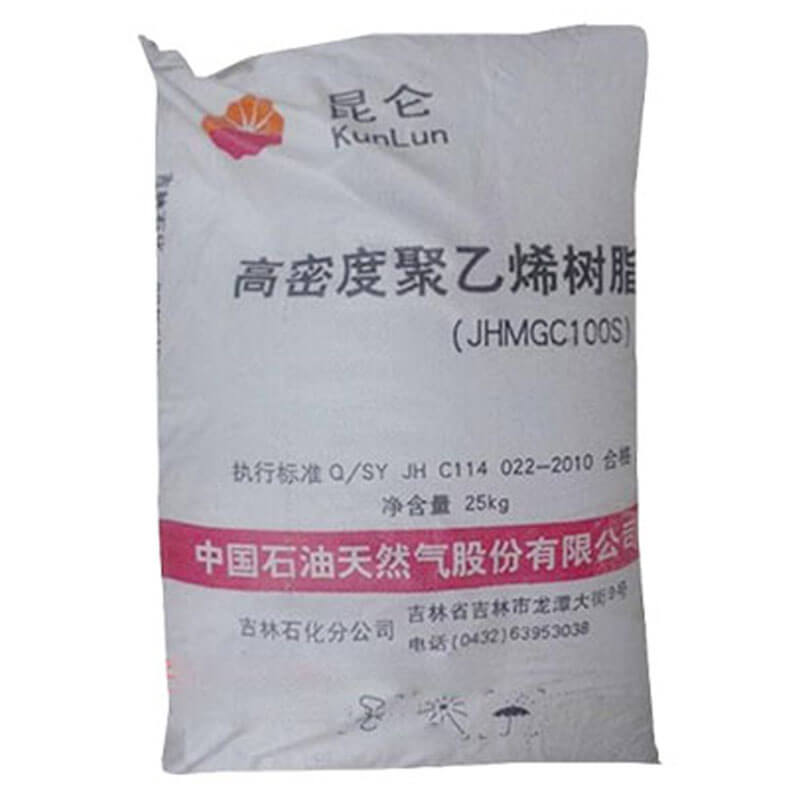
| Packing | High-Density Polyethylene JHMGC100S is packaged in 25 kg woven bags with moisture-proof liner, palletized and shrink-wrapped for safe transport. |
| Container Loading (20′ FCL) | 20′ FCL loading of HDPE JHMGC100S: 25kg bags shrink-wrapped on pallets, securely stowed to maximize capacity and prevent shifting. |
| Shipping | High-Density Polyethylene JHMGC100S ships as free-flowing pellets in moisture-proof bags or bulk containers. Keep dry and avoid direct sunlight. No hazardous classification, but handle to prevent contamination. Store at ambient temperature, away from heat sources and sharp objects. |
| Storage | Store High-Density Polyethylene JHMGC100S in a cool, dry, well-ventilated area away from direct sunlight, heat, and ignition sources. Keep containers tightly sealed to prevent moisture contamination and avoid contact with strong oxidizers. Protect from mechanical damage and prolonged UV exposure to maintain product quality. |
| Shelf Life | Shelf life is typically 12 months from manufacture when stored indoors, cool, dry, and protected from direct sunlight. |
In potable water mains, HDPE JHMGC100S is assessed against the PE100 classification defined by ISO 12162:2010, requiring a minimum required strength of 10.0 MPa derived from long-term hydrostatic strength testing under ISO 9080:2022 and product dimensional compliance to ISO 4427-2:2019; for European markets, EN 12201-2:2019 applies concurrently, while potable contact approvals are established through NSF/ANSI/CAN 61, AS/NZS 4020:2018, or WRAS depending on the destination utility specification. Formulation addition for black pressure pipe uses 2.0–2.5 wt% final carbon black content, achieved by metering a 40 wt% carbon-black-loaded polyethylene masterbatch at 5.0–6.0 wt% on the feed throat; non-black potable water service pipe replaces carbon black with blue or natural compound, keeping pigment masterbatch at 0.3–0.8 wt% and retaining acid scavenger plus hindered phenolic/phosphite antioxidant packages at the masterbatch supplier’s specified let-down ratio. Extrusion is performed on a grooved-feed single-screw extruder with L/D 30:1 and a compression ratio of 2.5:1, with barrel zones profiled from 190°C to 220°C and melt temperature capped at 230°C because residence times above 10 min at this temperature accelerate oxidative degradation and reduce oxidation induction time measured at 200°C under ISO 11357-6:2018. The melt passes through a spiral mandrel die, vacuum calibration sleeves held at −0.6 bar to −0.9 bar, and multi-stage spray cooling with water temperatures between 20°C and 40°C, followed by ultrasonic wall-thickness monitoring and cut-to-length at haul-off speeds matched to SDR 11, 13.6, or 17 dimensions. The resulting finished goods are municipal water distribution mains and service connection pipes from DN 20 to DN 1200, intended for buried operation at 10 bar to 16 bar design pressure and at temperatures not exceeding 25°C, with butt fusion, socket fusion, or electrofusion jointing on site.
The natural gas distribution pipe segment imposes a molecular architecture requirement combining sufficiently low melt flow rate, high slow crack growth resistance, and rapid crack propagation arrest that is not present in general-purpose injection-moulding HDPE; HDPE JHMGC100S is therefore processed under ISO 4437-1:2012, ISO 4437-2:2012, and EN 1555-2:2021, with additional rapid crack propagation resistance verified by the S4 test according to ISO 13477:2008 and slow crack growth evaluation under ISO 13479:2022. The certificate of analysis under ISO 1133-1:2022 at 190°C/5.0 kg normally places the melt mass-flow rate in the 0.20–0.40 g/10 min range; values above 0.45 g/10 min indicate a polymer outside the intended gas-pipe processing window and should be rejected for SDR 11 thick-wall production. The formulation for black gas pipe requires 2.0–2.5 wt% carbon black content in the final wall, obtained by adding a 40–50 wt% carbon black masterbatch at 4.0–6.0 wt%; for yellow gas pipe, carbon black is omitted and a cadmium-free organic yellow pigment masterbatch is metered at 0.5–1.0 wt% with a hindered amine light stabilizer package, because gas utility specifications in ISO markets forbid visual confusion with black water lines. Processing on a grooved-feed single-screw extruder with L/D 30:1 to 33:1 and barrel temperature profile 180°C to 220°C is followed by inline calibration, 100% ultrasonic wall thickness inspection, and final hydrostatic pressure testing at 1.5 × MOP for 24 h according to ISO 4437-2:2012; batch-to-batch variation in comonomer distribution shifts notched pipe failure times, so gas utilities require minimum failure time under ISO 13479:2022 at 8.0 bar hoop stress and 80°C of at least 1000 h for PE100 classification. The terminal product scope covers DN 20 to DN 630 SDR 11 or SDR 17.6 polyethylene gas mains and service lines operating at maximum pressures up to 10 bar for natural gas, with butt fusion and electrofusion jointing, and is further qualified for resistance to fuel condensates and odorant carry-over according to utility-specific testing rather than a single harmonized ISO chemical resistance annex.
Industrial mineral processing circuits use HDPE JHMGC100S for pressure and gravity transfer of abrasive silica-containing slurries; compliance is anchored to ISO 15494-1:2019 for industrial piping dimensions and to EN 12201-2:2019 only where potable-grade quality is coincidentally specified, while chemical resistance is validated case-by-case against ISO 4433-1:2018 immersion testing because no single ISO abrasion standard governs polyethylene slurry pipe. The compound is processed neat at 97.5–98.5 wt% HDPE JHMGC100S with 1.5–2.5 wt% carbon black masterbatch, while mineral-specific stabilizer packages are not added at the pipe extruder; wall-thickness schedules are increased by a sacrificial wear allowance of 10–20% above pressure-rated minimums under ISO 15494-1:2019 dimensions to offset internal erosion at bends and fittings. Extrusion uses a high-torque single-screw machine with L/D 30:1, grooved barrel, and die head designed for thick-walled SDR 11 to 26 pipes, with barrel temperatures 190°C to 230°C and screw cooling on the first zones to prevent feed bridging of the high-drag melt; after cooling, pipes are cut into 12 m lengths and butt-fusion welded on site, with flange adapters installed at pump stations and at transition points to steel lines. Terminal products are tailings transfer lines, thickener underflow pipes, and process water return mains in diameters from DN 90 to DN 1200, designed for pressures up to 16 bar at 20°C; published data for long-term abrasion rate of HDPE JHMGC100S in high-velocity silica slurry is limited, so a case-specific trial with 6–12 months thickness monitoring is required before design freeze.
Submarine outfall lines that discharge treated effluent into saline receiving bodies require simultaneous resistance to slow crack growth, point loads from seabed movement, and long-term external hydrostatic pressure; HDPE JHMGC100S is qualified under ISO 4427-2:2019 dimensions with additional verification of slow crack growth by ISO 13479:2022 notched pipe testing and butt fusion joint integrity by ISO 13953:2022, while ultraviolet exposure during onshore storage is managed by 2.0–2.5 wt% carbon black content in the final pipe wall. The pipe compound is prepared with 95.0–97.5 wt% HDPE JHMGC100S and 2.5–5.0 wt% of a 40–50 wt% carbon black masterbatch, with no filler or regrind allowed in marine outfall specifications unless documented lot traceability is provided to the certifying engineer. Extrusion is performed on a single-screw grooved-feed line with L/D 30:1, barrel profile 190°C to 220°C, vacuum sizing, and ultrasonic thickness logging; pipe sections are then butt-fused into strings of 100–500 m on land, ballasted with concrete collars at intervals calculated for negative buoyancy, and towed or bottom-pulled into position. The finished types are DN 315 to DN 2000 high-density polyethylene outfall, intake, and diffuser pipelines with SDR 17 to 26, installed in submerged service where hydrostatic collapse resistance under vacuum and external pressure is verified by ISO 9080:2022 long-term hydrostatic strength data rather than by short-term burst testing.
Closed-loop boreholes circulate a water-glycol fluid through HDPE JHMGC100S as a high-pressure conduit where long-term thermal ageing above 30°C and continuous fluid exposure separate the requirements from chlorine-stabilized potable water distribution; standards governing the final pipe system include ANSI/CSA C448 Series-16, EN 12201-2:2019, and ISO 4427-2:2019 for the PE100 pipe itself, while long-term hydrostatic strength at elevated temperature is evaluated under ISO 9080:2022 with the PE100 minimum required strength of 10.0 MPa at 20°C as the baseline. Formulation addition is typically 2.0–2.5 wt% carbon black via masterbatch for UV protection in above-ground headers, with 0.0 wt% carbon black for indoor or buried borehole pipe; thermal stabilizer packages are specified for continuous exposure up to 60°C and pressure up to 4 bar in circulating loops. Extrusion runs at 190°C to 220°C barrel set points on a grooved-feed single-screw extruder with L/D 30:1, producing SDR 11 and SDR 13.6 pipe that is butt-fused to form U-bends and manifold connections; the terminal product set includes DN 25 to DN 63 geothermal loop pipes and DN 90 to DN 160 headers, with service life determined by ISO 9080:2022 regression at 80°C and 60°C test temperatures and a minimum expected lifetime of 50 years only when the system is operated within the specified temperature and pressure envelope.
Cyclic pressure reversals and vacuum formation during pump shutdowns govern the wall-thickness selection for buried irrigation mainlines made from HDPE JHMGC100S; the pipe is produced to ISO 8779:2020 and ISO 4427-2:2019 dimensions where potable-quality compatibility is required, while above-ground laterals exposed to ultraviolet must carry 2.0–2.5 wt% carbon black across the full wall thickness. The extrusion formulation for buried non-potable agricultural mainlines is 97.5–98.5 wt% HDPE JHMGC100S with 1.5–2.5 wt% carbon black masterbatch or without carbon black where buried installation is guaranteed; above-ground use adds the same masterbatch at 5.0–6.0 wt% if a 40 wt% carbon black carrier is used, and the coextruded white or blue stripe is applied at 2–3% of the total wall thickness. Processing is performed on a single-screw extruder with grooved feed zone, L/D 30:1, and melt temperatures not exceeding 230°C, followed by vacuum calibration and on-line diameter gauging; pipeline sections are assembled with butt fusion or compression fittings for SDR 11 to 26 systems operating at 6 bar to 12.5 bar. Terminal finished products include DN 32 to DN 400 field crop mainlines, submains, and frost-resistant buried distribution laterals for agricultural irrigation systems; repeated pump start-stop cycles require fatigue verification under ISO 13479:2022 or project-specific cyclic pressure tests rather than assuming that PE100 hydrostatic strength alone covers cyclic loading.
Competitive High‑Density Polyethylene JHMGC100S prices that fit your budget—flexible terms and customized quotes for every order.
For samples, pricing, or more information, please contact us at +8618136850665 or mail to sales4@ascent-chem.com.
We will respond to you as soon as possible.
Tel: +8618136850665
Email: sales4@ascent-chem.com
Flexible payment, competitive price, premium service - Inquire now!
High-Density Polyethylene JHMGC100S is a pelletized ethylene copolymer supplied for injection-moulding operations in which adequate melt fluidity and part stiffness are required together. Under ISO 11469:2016, moulded articles produced from the resin carry the generic polymer marking >PE-HD<. Lot-acceptance testing is governed by the supplier certificate of analysis; published technical data for the grade commonly describe the control envelope shown in Table 1.
| Measured attribute | Standard method | Typical lot-acceptance range |
|---|---|---|
| Melt mass-flow rate | ISO 1133-1:2022, 190 °C/2.16 kg | 7.0–8.5 g/10 min |
| Density | ISO 1183-1:2019 | 0.955–0.960 g/cm³ |
| Tensile yield stress | ISO 527-2:2012, 50 mm/min | 25–30 MPa |
| Flexural modulus | ISO 178:2019, 2 mm/min | 1,100–1,500 MPa |
| Charpy notched impact strength, 23 °C | ISO 179-1:2020 | 4–7 kJ/m² |
| Vicat softening temperature | ISO 306:2022, Method A50 | 126–130 °C |
The primary conversion route is injection moulding of stackable crates, pails, thin-wall food-contact containers, caps and closures, industrial bins, and battery components. The grade is selected when cavity fill and cycle time take priority over melt strength. It is not intended for blown film, large-part extrusion blow moulding, or pressure pipe service where parison hang and slow crack growth resistance dominate the design envelope.
The practical injection-moulding window for JHMGC100S is bounded by the need to fill thin-wall sections while avoiding excessive residence time. Melt-temperature setpoints on general-purpose hydraulic machines are commonly programmed from hopper to nozzle as 180 °C, 210 °C, 215 °C, 220 °C, and 210 °C, with the nozzle setpoint not exceeding 230 °C. At melt temperatures above 230 °C, chain scission and oxidative degradation can reduce notched impact strength and shift colour in natural resin. Below 180 °C, the viscosity increase can cause short shots and excessive cavity-pressure loss.
Screw recovery should be checked against cooling time rather than forced by excessively high screw speed. Back pressure in the range 0.5–1.5 MPa and screw speed of 80–120 rpm on a 22:1 L/D general-purpose screw are typical; screws with Maddock shear elements may reduce melt-temperature fluctuation. Holding pressure is commonly set at 60–80% of peak fill pressure for 5–10 s, depending on gate freeze. Clamp force is selected from projected area and packing pressure; for a projected area of 250 cm² per cavity and packing pressure of 25–35 MPa, minimum clamp force exceeds 875 kN per cavity before safety factor. Surface moisture from condensation can produce splay; pellets exposed to high ambient humidity should be dried at 70–80 °C for 1–2 h before processing.
In thin-wall food-contact containers, cooling-channel placement and mould-temperature uniformity exert a stronger influence on part flatness than melt temperature alone. Typical mould shrinkage parallel to flow is 1.5–2.5% and transverse to flow is 1.0–2.0%, as measured on plaques under ISO 294-4:2018. A mould temperature set at 15–30 °C shortens cycle time but increases frozen-in orientation; a higher mould temperature of 40–50 °C improves dimensional stability but extends cooling time. Gate placement must avoid weld lines in impact-sensitive regions because weld-line notched Charpy impact can be 40–60% lower than the bulk value measured under ISO 179-1:2020.
JHMGC100S is differentiated from high-molecular-weight blow-moulding copolymers and bimodal HDPE pipe grades by an elevated melt mass-flow rate and a narrower molecular weight distribution. Blow-moulding grades maintain parison shape during hang time because their high-load melt flow rate under ISO 1133-1:2022, 190 °C/5 kg, typically falls between 1.5 g/10 min and 3.5 g/10 min. JHMGC100S is not designed for that rheological requirement. PE100 pipe grades are characterised by high molar-mass fractions and slow crack growth resistance measured by ISO 13479:2022 or ASTM F1473-23; their melt flow rate under 190 °C/5 kg is commonly 0.2–0.5 g/10 min, far below the injection-moulding flow window of JHMGC100S. This difference is purposeful: pipe damage tolerance requires high chain entanglement, whereas injection moulding prioritises cavity filling and cycle time.
| Attribute | JHMGC100S injection-moulding class | Blow-moulding HDPE class | PE100 pipe class |
|---|---|---|---|
| Melt flow rate | 7.0–8.5 g/10 min at 190 °C/2.16 kg | 0.3–0.7 g/10 min at 190 °C/2.16 kg for high-molecular-weight grades | 0.2–0.5 g/10 min at 190 °C/5 kg typical |
| Density | 0.955–0.960 g/cm³ | 0.952–0.958 g/cm³ | 0.950–0.960 g/cm³ |
| Primary conversion | injection moulding | extrusion blow moulding | pipe extrusion |
| Key rheological demand | low viscosity for cavity fill | high melt strength for parison hang | broad molar-mass distribution for slow crack resistance |
Environmental stress cracking resistance in HDPE depends on comonomer content, crystallinity, and external stress. JHMGC100S is not positioned as a long-term pressure-pipe resin; when stress cracking is a design requirement, the component must be evaluated under ASTM D1693-15, Condition B, 100% Igepal CO-630, with F50 reporting. Published data for this specific configuration is limited, and generalisations from blow-moulding or pipe grades should not be substituted for component-level testing. Compatibility with strong oxidising acids, concentrated nitric acid, and halogenated organic solvents is limited. Swelling in aliphatic or aromatic hydrocarbons causes dimensional change, and tensile yield stress may decline after extended immersion. The material should not be exposed to oxidising agents above 40 °C without pre-qualification. At temperatures below -30 °C, notched specimens may fail in a brittle mode.
On injection-moulding floors, screw recovery time often determines whether JHMGC100S can meet thin-wall cycle targets. On a 36 mm diameter screw with 22:1 L/D, recovery time should be checked against cooling time; if screw speed is elevated above 150 rpm to force recovery, melt-temperature overshoot and screw barrel wear increase. The resulting thermal history can shift the notched Charpy impact to the lower end of the specification envelope. Hydraulic check-ring leakage manifests as shot-size drift and cavity-packing inconsistency; the defect is often misdiagnosed as a material viscosity shift when the actual source is a worn non-return valve. A screw and barrel thermocouple calibration tolerance of ±2 °C is recommended; larger deviations across zones produce inconsistent melt homogeneity and dimensional variation in thin-wall parts.
Hopper-bridging and feed-throat blockage occur most often when fines or regrind are introduced above 20% by mass. Variability in regrind particle size can alter bulk density at the feed throat and produce shot-mass fluctuation, even though the base resin melt flow rate remains within specification. For this reason, lot-acceptance testing should include fines content where regrind is recycled at high ratios.
Food-contact status cannot be assumed from the base polymer alone. The base olefin polymer may comply with FDA 21 CFR 177.1520 for high-density polyethylene when the additive package also meets that section; however, each finished article must be tested under the intended conditions of use and simulants specified in Regulation (EU) No 10/2011 or FDA food-contact guidance. REACH registration obligations apply to the ethylene monomer and additives, not to the polymer as a monodisperse substance. RoHS Directive 2011/65/EU compliance requires confirmation that color concentrates and processing aids do not introduce restricted lead, cadmium, mercury, hexavalent chromium, polybrominated biphenyls, or polybrominated diphenyl ethers. Medical packaging applications fall outside the scope of this grade unless bioburden and cytotoxicity validation is completed under ISO 10993-5:2009.