| HS Code | 228328 |
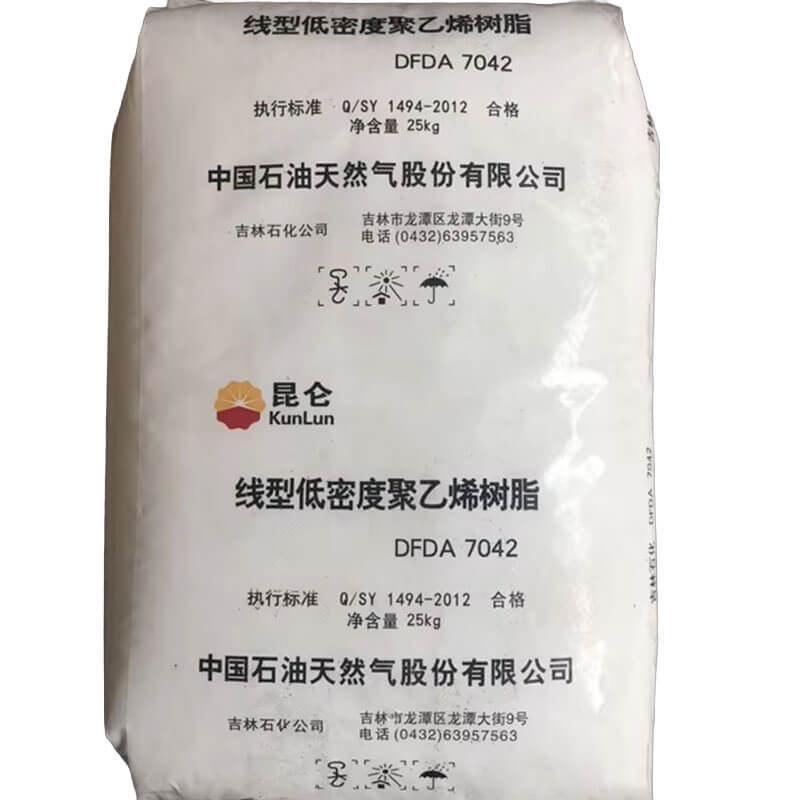
| Product | Linear Low-Density Polyethylene DFDA-7042 |
| Density | 0.918 g/cm³ |
| Melt Flow Rate | 2.0 g/10 min (190°C, 2.16 kg) |
| Melting Point | 123°C |
| Vicat Softening Point | 104°C |
| Tensile Strength At Yield | 13.0 MPa |
| Elongation At Break | 650% |
| Flexural Modulus | 280 MPa |
| Brittle Temperature | -80°C |
| Shore Hardness D | 55 |
| Thermal Conductivity | 0.35 W/m·K |
As an accredited Linear Low‑Density Polyethylene DFDA-7042 factory, we enforce strict quality protocols—every batch undergoes rigorous testing to ensure consistent efficacy and safety standards.
| Packing | Linear Low-Density Polyethylene DFDA-7042 is supplied in 25 kg sealed polyethylene bags, palletized and stretch-wrapped for safe transport. |
| Container Loading (20′ FCL) | 20′ FCL container loading of LLDPE DFDA-7042: 25kg bags palletized, ~10-12 MT per container, safe, dry stowage. |
| Shipping | Linear Low-Density Polyethylene DFDA-7042 is a non-hazardous plastic resin supplied as free-flowing pellets. It ships in 25 kg bags, bulk bags, or railcars, and must be kept dry, clean, and away from direct heat. Standard dry containers or covered trucks ensure safe, contamination-free transport. |
| Storage | Store Linear Low-Density Polyethylene DFDA-7042 in a cool, dry, well-ventilated area away from direct sunlight, heat, and open flames. Keep containers sealed to prevent moisture and contamination. Avoid exposure to strong oxidizers. Store indoors, off the floor, and protect bags from tearing. Follow good housekeeping to minimize dust accumulation and fire risk. |
| Shelf Life | Shelf life is indefinite if stored in original sealed packaging, protected from heat, moisture, and direct sunlight. |
On a 65 mm grooved-feed blown film extruder with a 30:1 L/D barrier screw, DFDA-7042 pellets are processed at barrel set temperatures from 175 °C to 200 °C, with a die temperature of 190–210 °C. The resin’s melt flow rate of 2.0 g/10 min under ISO 1133-1:2022 conditions (190 °C, 2.16 kg) and density of 0.918–0.922 g/cm³ under ASTM D1505 position the grade in the low-melt-strength region of butene LLDPE film resins; bubble diameter oscillation and frost-line drift begin when blow-up ratio exceeds 2.5 unless a high-pressure LDPE homopolymer with melt flow rate 0.25–0.5 g/10 min is dry-blended at 20–30 wt%. For heavy-duty industrial liners, the formulation is typically set at 70–100 wt% DFDA-7042, 0–30 wt% LDPE 2426H, 1–3 wt% silica-based anti-block masterbatch containing 10–15 wt% active synthetic silica, and 200–800 ppm active fluoropolymer processing aid to suppress die-lip build-up and melt fracture. Compliance for this non-food industrial track is anchored to EU Directive 94/62/EC packaging waste requirements, CONEG heavy metals limits with total lead, mercury, cadmium and hexavalent chromium below 100 mg/kg combined, and REACH Regulation (EC) No 1907/2006 SVHC screening for EU-bound shipments. Three-layer blown film equipment with a die gap of 1.8–2.3 mm, die diameter of 250–400 mm, and blow-up ratio of 2.0–2.5 produces film thicknesses between 60 µm and 200 µm; frost-line height is held at 4–8 die diameters to balance transverse direction elongation and dart impact retention. Terminal products include construction rubble bags, hazardous-waste overpack liners, agricultural bulk container liners, and high-strength drum liners, where puncture resistance is verified under ISO 7765-1 or ASTM D1709A at -20 °C to simulate cold-climate handling.
| Parameter | Test method | Published range for DFDA-7042 film grade |
|---|---|---|
| Melt flow rate | ISO 1133-1:2022 / ASTM D1238 | 1.8–2.2 g/10 min at 190 °C, 2.16 kg |
| Density | ISO 1183-1:2019 / ASTM D1505 | 0.918–0.922 g/cm³ |
| Tensile yield strength, 50 µm blown film | ISO 527-3 | 10–12 MPa MD / 10–11 MPa TD |
| Elongation at break, 50 µm blown film | ISO 527-3 | 600–800% MD / 700–900% TD |
| Dart drop impact, 50 µm blown film | ASTM D1709A | 80–120 g |
| Haze, 50 µm blown film | ASTM D1003 | 8–15% |
Agricultural covering film lines running DFDA-7042 at 12–16 m layflat width typically position the resin in the core and one skin layer of a three-layer coextrusion die, while the second skin layer contains a high-UV-stability LLDPE or EVA component. Under EN 13206:2017 covering films for agriculture and horticulture, the film must meet thickness tolerance, mechanical strength, and weathering requirements; UV durability is tested under ISO 4892-2 using xenon-arc weathering with 340 nm irradiance at 0.35–0.55 W/m² depending on exposure protocol, or under ISO 4892-3 fluorescence-UV conditions. The formulation for a 24–36-month greenhouse service interval typically comprises 60–85 wt% DFDA-7042, 10–20 wt% LDPE homopolymer for bubble stability, and 8–12 wt% of a UV masterbatch containing hindered amine light stabilizers and benzotriazole or benzophenone UV absorbers; silage clamp covers requiring only 12–18-month exposure are formulated at the lower end of the UV masterbatch range, while installations above 1,500 m elevation shift the addition toward 12 wt% because of elevated UV-B irradiance. Three-layer blown film lines with die diameters of 250–500 mm, die gaps of 1.8–2.5 mm, and blow-up ratios of 1.8–2.2 run at output rates of 400–1,000 kg/h, producing film thicknesses from 120 µm for low tunnels to 200 µm for multi-season greenhouse covers. Terminal product types include greenhouse roof films, soil fumigation barrier films, silage clamp side sheeting, and low-tunnel crop covers; direct contact with agrochemicals requires compatibility validation under EN 17098-1 or the intended-use contact test specified by the chemical registrant.
On cast film lines, the primary process conflict with DFDA-7042 is the combination of neck-in at the die exit and low quench stress retention, which reduces gauge uniformity unless optimized edge pinning is used. In cast stretch film production, the resin is typically dry-blended at 60–85 wt% DFDA-7042, 10–25 wt% of a metallocene LLDPE with density 0.910–0.918 g/cm³ to raise elastic recovery, 1–3 wt% polyisobutylene or low molecular weight tackifier masterbatch, and 0.5–1.5 wt% erucamide slip masterbatch; the addition ratio of DFDA-7042 is capped below 85 wt% because above that level the film exhibits a measurable drop in pre-stretch retention and an increase in transverse direction tear under ISO 6383-2. Process conditions include a slot die gap of 0.5–0.8 mm, melt temperature of 250–280 °C, and chill roll temperature of 20–25 °C; an air knife and vacuum box are run at differential pressures sufficient to generate 0.2–0.5 N/mm of pinning force per unit die width, with edge trim of 3–5% to remove neck-in thickening. Compliance is anchored to ASTM D5458 for cling stretch wrap peel force and ISO 527-3 for tensile properties; food contact uses additionally require FDA 21 CFR 177.1520 and EU Regulation (EU) No 10/2011 migration testing under the intended time-temperature profile. Terminal products include hand pallet wrap at 12–15 µm, machine stretch film at 17–23 µm, bundling film, and silage bale wrap; published data for DFDA-7042 in high-performance high-speed machine wrap with pre-stretch above 250% is limited, and in such configurations a metallocene-rich formulation is usually required.
Sealant-layer extrusion for laminated flexible pouches uses DFDA-7042 at 65–90 wt% blended with 10–30 wt% LDPE homopolymer and 1–2 wt% erucamide slip masterbatch; anti-block masterbatch is added at 2–4 wt% to prevent rewind blocking after corona treatment. The heat-seal web is manufactured on single-layer or coextruded cast and blown film lines at a thickness of 20–50 µm, followed by inline surface treatment to 38–42 mN/m wetting tension. Food contact compliance is governed by FDA 21 CFR 177.1520 for olefin polymers and EU Regulation (EU) No 10/2011 with overall migration limit 10 mg/dm² under Annex V; China GB 9685-2016 governs additive consumption for exports to China. Lamination to BOPET, BOPP, or BOPA is carried out with solventless polyurethane adhesive at 2.0–3.5 g/m² and cured at 30–40 °C for 24–48 h; however, DFDA-7042 sealant layers above 40 µm require lower ionomer or plastomer addition because of heat-seal initiation temperature drift beyond 110 °C observed during hot-tack testing under ASTM F1921. Terminal products include frozen food pouches, snack bags, form-fill-seal pillow packs, quad seal bags, and stand-up pouch inner sealing films.
When a blow-up ratio of 2.2 is maintained at a frost-line height of 8 die diameters on a 350 mm die, DFDA-7042 blown film intended for heavy-duty consumer sacks develops a transverse direction elongation profile that is sensitive to the cooling rate of the outer bubble layer. In form-fill-seal sack conversion, the resin is used at 70–90 wt% with 10–20 wt% LDPE or high-strength LLDPE hexene grades, plus 1–2 wt% slip/anti-block masterbatch; carbon black masterbatch for UV protection or opacity is added at 3–6 wt% in non-food sack applications. The extrusion process uses a 1.8–2.3 mm die gap, melt temperature 185–205 °C, and internal bubble cooling at 50–80 Pa to stabilize the bubble; film thickness ranges from 80 µm to 150 µm. Compliance for heavy-duty sacks is tested under ISO 7765-1 instrumented puncture test and ISO 527-3 tensile test; for building material or pet food sacks requiring high drop-fill resistance, seal integrity is also evaluated under ISO 11607-1 after simulated transportation. Terminal products include gusseted heavy-duty shipping sacks, pet food bags, mineral filler bags, and FFS pouches for granular detergents.
| Application track | Compliance standard | Relevant parameter or limit |
|---|---|---|
| Heavy-duty industrial liners | EU 94/62/EC, CONEG, REACH | Heavy metals sum <100 mg/kg; SVHC screening required |
| Agricultural covering films | EN 13206:2017, ISO 4892-2 | Weathering, thickness tolerance, tensile retention |
| Cast stretch film | ASTM D5458, ISO 527-3, FDA 21 CFR 177.1520 | Cling force, tensile properties, migration |
| Laminated sealant web | EU 10/2011, FDA 21 CFR 177.1520, GB 9685-2016 | Overall migration <10 mg/dm²; additive restrictions |
| Heavy-duty sacks | ISO 7765-1, ISO 527-3 | Puncture energy, tensile strength, seal integrity |
Competitive Linear Low‑Density Polyethylene DFDA-7042 prices that fit your budget—flexible terms and customized quotes for every order.
For samples, pricing, or more information, please contact us at +8618136850665 or mail to sales4@ascent-chem.com.
We will respond to you as soon as possible.
Tel: +8618136850665
Email: sales4@ascent-chem.com
Flexible payment, competitive price, premium service - Inquire now!
Linear low-density polyethylene DFDA-7042 is a butene-based ethylene/1-butene copolymer supplied as pelletized resin for blown film extrusion. The grade is produced by low-pressure gas-phase copolymerization, giving a linear backbone with short-chain branches that differs from autoclave LDPE long-chain architecture. Bulk density is typically 0.48–0.55 g/cm³. The material is specified for liners, refuse bags, produce bags, agricultural film, carrier bags, and lamination film, either as neat resin or in blends with autoclave LDPE at addition levels up to 30 wt% to improve bubble stability. Producer data sheets place the density at 0.918–0.922 g/cm³ and the melt flow rate at 2.0 g/10 min under 190°C and 2.16 kg load according to ISO 1133-1:2022 or ASTM D1238.
The melt flow rate determined under 190°C and 2.16 kg load has a nominal value of 2.0 g/10 min. Incoming lot verification commonly applies a tolerance of ±0.2 g/10 min, while producer certificates may report a release range of 1.8–2.2 g/10 min. Density measured by ASTM D1505 or ISO 1183-2 after conditioning at 23°C lies within 0.918–0.922 g/cm³. A higher density inside this range increases tensile stiffness but reduces dart impact and tear initiation resistance. The differential scanning calorimetry melting peak under ISO 11357-3 at 10 K/min is typically 122–126°C, with crystallization onset near 106–108°C. These values are relevant to post-extrusion cooling and heat-seal dwell temperature selection.
On a 65 mm single-screw blown film line with 30:1 L/D and a 200 mm die, barrel set points from feed to die are typically 170°C, 190°C, 200°C, 205°C, 210°C, with die temperature 210°C and measured melt temperature at 199–205°C. Die gaps of 1.2–2.0 mm and blow-up ratios of 2.0:1–3.0:1 produce stable bubble geometry. Frost line heights below 6 die diameters reduce machine-direction orientation and lower tear strength, while frost line heights above 12 die diameters increase blocking tendency. On lines with limited bubble stabilization, addition of 10–30 wt% autoclave LDPE is used to prevent bubble flapping because the long-chain branched fraction raises melt tension. Pre-drying is not normally required unless pellet surface moisture exceeds 0.05 wt% after condensation; then a 70°C desiccant drying step for 2 h is applied.
Mechanical property values are strongly gauge- and orientation-dependent. At 50 µm film thickness and 2.5:1 blow-up ratio, producers report tensile strength at break of 25–35 MPa in the machine direction and 22–30 MPa in the transverse direction according to ISO 527-3. Elongation at break is typically 650–800% in the machine direction and 700–850% in the transverse direction. Dart drop impact according to ASTM D1709 Method A is commonly 90–130 g at 50 µm, decreasing to 50–80 g at 25 µm. Elmendorf tear strength according to ASTM D1922 is usually 100–150 g in the machine direction and 350–500 g in the transverse direction at 50 µm. Haze measured by ASTM D1003 at 50 µm is in the 10–18% range, and 45° gloss by ASTM D2457 is 55–70 gloss units.
| Parameter | Test method | DFDA-7042 | Autoclave LDPE film grade | Metallocene octene-LLDPE film grade |
|---|---|---|---|---|
| Melt flow rate, 190°C/2.16 kg | ASTM D1238 | 2.0 g/10 min | 0.25–0.35 g/10 min | 0.5–1.2 g/10 min |
| Density, 23°C | ASTM D1505 | 0.918–0.922 g/cm³ | 0.923–0.925 g/cm³ | 0.916–0.922 g/cm³ |
| Dart impact, 50 µm film | ASTM D1709 Method A | 90–130 g | 60–90 g | 200–500 g |
| Seal initiation temperature | ASTM F88 | 105–115°C | 120–130°C | 95–105°C |
| Elmendorf tear, MD/TD, 50 µm film | ASTM D1922 | 100–150 g / 350–500 g | 50–80 g / 100–150 g | 200–350 g / 400–650 g |
Compared with autoclave LDPE of similar density, DFDA-7042 has lower long-chain branching frequency, which reduces melt tension at the die and requires more precise bubble control. The butene short-chain branch distribution provides higher tensile elongation and dart impact than LDPE but lower than hexene- or octene-based metallocene LLDPE grades. The seal initiation temperature of DFDA-7042 is approximately 105–115°C, lower than typical autoclave LDPE at 120–130°C and higher than metallocene grades at 95–105°C. This intermediate sealing behavior is relevant for vertical form-fill-seal lines where seal-bar dwell time is fixed and the seal must develop without interfacial delamination.
On form-fill-seal lines, heat-seal initiation temperature is commonly measured by ASTM F88 or ASTM F1921 using 0.5 MPa seal pressure and 0.5 s dwell time. At a seal-bar temperature of 110°C, seal strength reaches 8–12 N/25 mm on 50 µm film, while at 130°C the seal strength enters the plateau region of 12–16 N/25 mm. Below 100°C, seal strength is typically below 3 N/25 mm, which limits hot-fill and retort-style packaging. Blending 15–20 wt% of a propylene-based plastomer or a lower-melting metallocene grade can reduce seal initiation by 5–10°C, but also lowers stiffness and raises blocking tendency. Processing above 240°C is not recommended because thermal-oxidative degradation accelerates and gel formation can occur, particularly when the resin is combined with amine-bearing slip agents.
DFDA-7042 is not formulated with slip or antiblock as standard; converters typically add 1–3 wt% of a suitable masterbatch to control coefficient of friction. Food-contact suitability requires verification under FDA 21 CFR 177.1520 and EU Regulation 10/2011. Overall migration testing according to EN 1186 and specific migration testing for the selected additive package are the responsibility of the converter. Published data for specific film-gauge and additive combinations remains limited; therefore final article compliance must be confirmed on production-scale runs under end-use conditions.