| HS Code | 289000 |
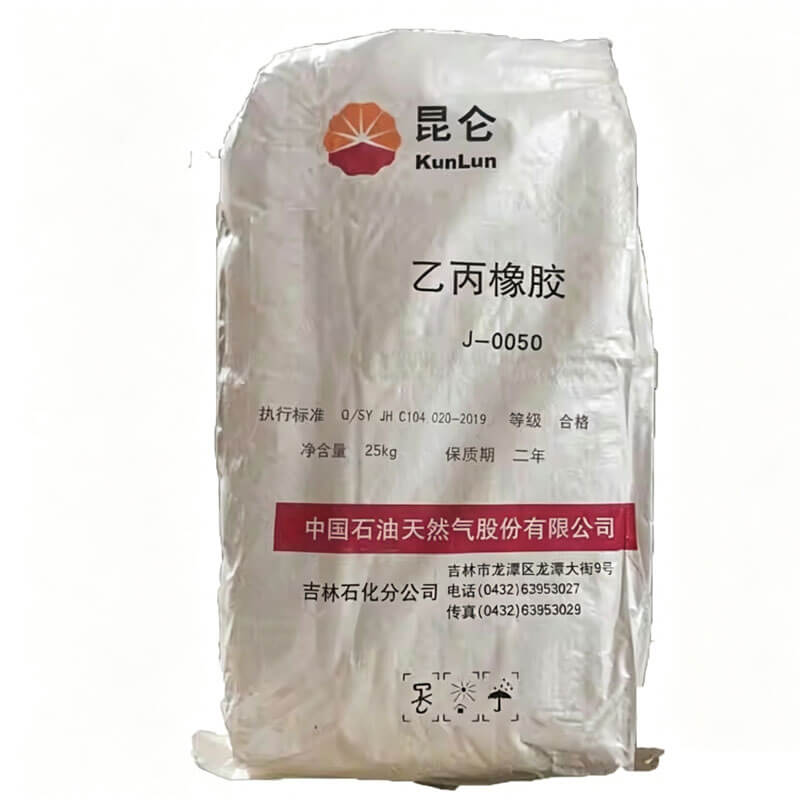
| Product Name | Ethylene-Propylene Rubber J-0050 |
| Material Type | Ethylene-Propylene copolymer (EPM) |
| Appearance | White to off-white bales |
| Density | 0.86 g/cm³ |
| Mooney Viscosity Ml 1 Plus 4 At 125 C | 50 MU |
| Ethylene Content | 50% by weight |
| Propylene Content | 50% by weight |
| Volatile Content | ≤0.5% |
| Ash Content | ≤0.3% |
| Glass Transition Temperature | -55 °C |
| Tensile Strength Vulcanized | ≥10 MPa |
| Elongation At Break Vulcanized | ≥300% |
| Hardness Shore A Vulcanized | 50±5 |
| Service Temperature Range | -50 °C to +150 °C |
| Volume Resistivity | 10¹⁵ Ω·cm |
As an accredited Ethylene‑Propylene Rubber J‑0050 factory, we enforce strict quality protocols—every batch undergoes rigorous testing to ensure consistent efficacy and safety standards.
| Packing | Ethylene‑Propylene Rubber J‑0050 is supplied in 25 kg net polyethylene‑lined paper bags, palletized and stretch‑wrapped for protection. |
| Container Loading (20′ FCL) | 20′ FCL container loading for Ethylene‑Propylene Rubber J‑0050: palletized bales in cartons, stowed securely to maximize capacity and prevent shifting. |
| Shipping | Ethylene-Propylene Rubber J-0050 ships as a non-hazardous polymer pellet or bale. It should be packed in clean, dry bags, drums, or sealed containers to prevent contamination and moisture absorption. No special transport classification required; keep away from heat, ignition sources, and direct sunlight during transit. |
| Storage | Store Ethylene‑Propylene Rubber J‑0050 in a cool, dry, well‑ventilated area, away from direct sunlight, heat, flames, and strong oxidizing agents. Keep containers tightly sealed to prevent moisture ingress and contamination. Avoid compression or stacking damage. Maintain stable temperatures and follow manufacturer’s shelf‑life guidelines. Proper storage preserves polymer properties and processability. |
| Shelf Life | Shelf life is typically 2 years from manufacture if stored in a cool, dry, sealed container away from sunlight. |
Dense and sponge automotive weatherstrip compounds using J-0050 as the sole elastomer are processed on vented cold-feed extruders of 60 mm to 90 mm diameter, with L/D ratios from 20:1 to 24:1 and screw profiles that hold melt temperature below 105°C in the head zone to avoid scorch in sulfur-donor systems. The dense skin compound uses 100 phr J-0050, 80–120 phr N550 carbon black, 50–90 phr paraffinic process oil, 5.0 phr zinc oxide, 1.0 phr stearic acid, 1.0–1.5 phr sulfur, 1.5 phr MBTS, 0.8 phr ZDBC, and 0.8 phr DPTT; the sponge core adds 2.0–4.0 phr azodicarbonamide blowing agent and reduces N550 to 60–90 phr to preserve cell structure. Compliance is evaluated under ISO 188 heat ageing, ISO 1431-1 ozone cracking, ASTM D395-18 compression set, and ASTM D1056 cellular rubber classification, with OEM specifications such as GMW 15359 and DBL 5517 setting additional abrasion, low-temperature flexibility, and fogging limits. Co-extrusion lines combine dense skin, sponge body, and embedded metal carrier through crosshead dies with land length-to-gap ratios of 10:1 to 15:1, followed by microwave or hot-air pre-cure and salt bath continuous vulcanization at 200–230°C for 2–5 min depending on wall section. Production-scale batch records show that a Mooney viscosity shift of ±5 ML(1+4) 100°C between polymer lots requires adjusting carbon black and oil loadings by approximately ±2 phr to maintain final Shore A and extrusion swell. Terminal products include beltline seals, glass run channels, door opening seals, hood-to-cowl seals, trunk seals, and co-extruded roof ditch moldings.
In low-voltage flexible cable insulation and sheathing, J-0050 is compounded with calcined clay and alumina trihydrate instead of carbon black to maintain dielectric strength and flame retardance. A typical starting formulation uses 100 phr J-0050, 60–100 phr calcined clay, 80–120 phr ATH, 5.0 phr zinc oxide, 1.0 phr stearic acid, 2.0 phr antioxidant RD, 2.5–4.0 phr dicumyl peroxide (40% active), and 1.0–2.0 phr TMPTMA coagent. The compound is processed on a cold-feed extruder with L/D 20:1 and compression ratio 2.5:1, feeding a continuous vulcanization tube where the cable passes through high-pressure steam at 1.2–1.6 MPa and 180–220°C. Moisture pick-up in calcined clay is the main batch-to-batch variable; when ambient relative humidity exceeds 60%, the filler is pre-dried at 80–90°C for 2–4 h to prevent steam-induced porosity in insulation. Compliance is anchored to IEC 60245 for rubber-insulated flexible cables, UL 44 for thermoset-insulated wire, EN 50363-1 for insulation compound requirements, and ISO 4892-2 for Xenon weatherability of jacketing compounds. Terminal products include H05RN-F and H07RN-F flexible cords, welding cables, crane trailing cables, submersible pump cables, and motor lead wire rated for continuous conductor temperatures up to 90°C.
| Component (phr) | Insulation compound | Sheathing compound |
|---|---|---|
| J-0050 | 100 | 100 |
| Calcined clay | 85 | 60 |
| Alumina trihydrate | 110 | 100 |
| Zinc oxide | 5.0 | 5.0 |
| Stearic acid | 1.0 | 1.0 |
| Antioxidant RD | 2.0 | 2.0 |
| Dicumyl peroxide 40% active | 3.5 | 3.0 |
| TMPTMA coagent | 1.5 | 1.0 |
Polypropylene-based thermoplastic olefin formulations use J-0050 as the elastomeric impact-modifying phase in twin-screw reactive blending at barrel temperatures of 180–220°C and screw speeds of 300–500 min⁻¹ on a co-rotating extruder with L/D 40:1. A representative automotive TPO compound contains 60–80 wt% PP homopolymer or impact copolymer, 10–25 wt% J-0050, 10–20 wt% talc, 0.2–0.5 wt% hindered phenolic antioxidant, and 0.2–0.5 wt% phosphite secondary antioxidant. Maleic anhydride grafting is employed only when primerless adhesion to polyurethane foam or glass is required; published data for J-0050 in specific maleic anhydride grafting under supercritical CO₂-assisted extrusion is limited. Impact performance is measured under ISO 179-1 Charpy notched impact, ISO 527-2 tensile properties, and ISO 6603-2 puncture resistance, while automotive interior materials must satisfy VDA 278 VOC and fogging limits and maintain ISO 1133-1:2022 melt flow rates between 8 and 20 g/10 min for injection molding. Production-scale lines have observed low-temperature impact failure at −30°C when the elastomer domain size exceeds 5 μm due to insufficient distributive mixing; therefore the screw is configured with three high-shear kneading blocks and a downstream vacuum vent at −0.08 MPa to remove residual moisture and low-molecular-weight volatiles. Terminal products include automotive bumper fascias, instrument panel skins, door panel bolsters, airbag covers, cowl covers, and battery tray components.
Achieving seam peel strength above the specified minimum in EPDM single-ply roofing systems when J-0050 is the base polymer depends on filler surface polarity and cure-pack consolidation. J-0050 is compounded with high-structure carbon black N650 at 80–120 phr and paraffinic process oil at 60–90 phr; zinc oxide at 5.0 phr and stearic acid at 1.0 phr support a sulfur cure system consisting of 1.0–1.5 phr sulfur, 1.5 phr MBT, and 0.8 phr TMTD. Mineral fillers such as calcium carbonate and clay are generally avoided where maximum seam strength is required because they raise surface polarity and reduce butyl seam tape wetting. The membrane is produced by internal Banbury mixing, 2-roll mill sheeting, and 3- or 4-roll calendering to nominal thicknesses of 1.1 mm, 1.5 mm, or 2.0 mm, followed by autoclave or rotocure continuous vulcanization at 150–180°C for 20–40 min. Seam strength and membrane classification are tested under ASTM D4637, tear resistance under ISO 34-1, Xenon weather resistance under ISO 4892-3 for 5000 h, and installed-system fire performance under EN 1187 or ASTM E108; full system compliance for roof waterproofing references EN 13956. Production experience shows that winding calendered sheet with internal temperature above 40°C can cause inter-ply sticking and seam contamination, so forced cooling to below 35°C before wind-up is maintained. Terminal products include non-ballasted EPDM roof membranes, fully adhered roof systems, pond liners, water feature liners, and pre-fabricated pipe boot flashing.
Radiator and heater hose compounds using J-0050 as the base elastomer are formulated with 60–90 phr N550 carbon black, 20–50 phr paraffinic oil, 5.0 phr zinc oxide, 1.0 phr stearic acid, and either a sulfur-donor system of 1.0–1.5 phr sulfur, 1.5 phr MBTS, and 0.8 phr TMTD for polyester-reinforced constructions, or 4.0–6.0 phr dicumyl peroxide plus 1.0–2.0 phr triallyl isocyanurate for unreinforced molded hoses requiring low compression set after extended-life coolant exposure. The selection conflict is process-critical: peroxide decomposition residues can attack polyester braid at continuous service temperatures above 135°C, reducing burst strength, so sulfur-donor cures are specified for fabric-reinforced coolant hose even though compression set is higher. Production equipment includes pin extruders for tubular preforms, accumulator-assisted braiders applying polyester or aramid yarn at 2-over-2 or 3-over-3 patterns, and autoclave curing at 150–160°C for 30–60 min. Compliance is assessed under SAE J20 for reinforced elastomeric coolant hoses, ISO 9283 for light-duty coolant hose physical tests, ASTM D380 for rubber hose testing, and ASTM D2240 for Shore A hardness. Terminal products include molded radiator hoses, heater hoses, intercooler hose bends, turbocharger coolant lines, and expansion tank overflow hose.
Because repeated detergent and hot-water exposure in household appliances imposes simultaneous requirements of low compression set, surface defect control, and minimal plasticizer bloom, J-0050 is formulated in appliance gasket compounds with 80–110 phr N550 or N650 carbon black, 40–70 phr white paraffinic oil, 5.0 phr zinc oxide, 1.0 phr stearic acid, and an efficient sulfur/sulfenamide system of 1.2–1.8 phr sulfur, 1.5 phr CBS, and 0.8 phr ZDBC; peroxide-cured versions at 3.0–5.0 phr dicumyl peroxide are selected for detergent exposure above 90°C. The gasket is produced by injection molding on reciprocating-screw machines with clamp forces from 800 to 2,500 kN, mold temperatures of 170–190°C, and injection pressures of 70–100 MPa; cure time is set from rheometer t90 values typically between 3 and 8 min depending on cavity depth. Multi-cavity production tools have shown that unbalanced runner systems produce a ±2 Shore A hardness variation across cavities and visible knit lines at weld points; cold-runner temperature is maintained at 70–80°C and vent depth at 0.02–0.05 mm to control these defects. Compliance standards include IEC 60335-1 for household appliance safety, UL 50E for gasket environmental enclosure tests, ISO 1817 for resistance to liquids and detergents, and ASTM D1056 for cellular gasket materials where sponge door seals are manufactured. Terminal products include washing machine door gaskets, dishwasher tub seals, dryer drum seals, refrigerator door gaskets, and water softener tank seals.
Competitive Ethylene‑Propylene Rubber J‑0050 prices that fit your budget—flexible terms and customized quotes for every order.
For samples, pricing, or more information, please contact us at +8618136850665 or mail to sales4@ascent-chem.com.
We will respond to you as soon as possible.
Tel: +8618136850665
Email: sales4@ascent-chem.com
Flexible payment, competitive price, premium service - Inquire now!
Ethylene‑Propylene Rubber J‑0050 is a saturated ethylene‑propylene copolymer supplied as a neat bale for peroxide-cured compounding. The grade is positioned in the 50-Mooney viscosity class; a representative certificate of analysis lists Mooney viscosity ML 1+4 at 125 °C of 48–52 MU when measured to ASTM D1646-19a, ethylene content of 49–51 wt% by ASTM D3900, volatile matter below 0.5 wt% by ASTM D5668, and ash below 0.1 wt%. The termonomer content by ASTM D6047 is below the method quantification limit, confirming that J‑0050 is an EPM rather than an EPDM terpolymer. This distinction defines the product: sulfur-accelerated cure is not available, and the compounder must use organic peroxide plus coagent chemistry. The designation J‑0050 identifies a Mooney-centered product family; the neat polymer contains no carbon black, oil, or curative, and all downstream values are therefore compound-specific.
Handling records from ambient warehouses indicate that free-standing bale stacks of J‑0050 maintain dimensional stability at floor temperatures below 40 °C. Storage above 45 °C accelerates cold flow at block edges and can cause the polyethylene interleaf to adhere to the rubber surface, creating feed irregularity on cold-feed extruders. The polymer is packaged in 25 kg bales on 1,050 kg skids. Because the saturated backbone is less prone to oxidative skin formation than high-diene EPDM, cold storage is not required, but first-in-first-out rotation is specified to reduce batch-to-batch variation in green strength.
The principal difference is the absence of pendant unsaturation. An ENB-bearing EPDM with 4.3–4.7 wt% ethylidene norbornene permits sulfur-accelerated vulcanization with thiuram, dithiocarbamate, and sulfenamide packages, yielding rapid crosslink formation but generating residual cure-system byproducts. J‑0050 contains only saturated backbone carbon atoms; the termonomer content by ASTM D6047 is below the quantification limit. Consequently, sulfur-accelerated systems do not form an adequate crosslink network. Vulcanization is accomplished with organic peroxide and a di- or trifunctional coagent, most commonly trimethylolpropane trimethacrylate or triallyl cyanurate. The practical effect on production lines is that J‑0050 avoids nitrosamine-generating accelerators, exhibits lower compression set after 70 h at 150 °C in peroxide-cured compounds, and does not produce the sulfur bloom associated with curative migration kinetics in polymer matrices. In return, the cure window is narrower: a dicumyl peroxide compound at 180 °C typically reaches t90 in 6–9 min, while a matched sulfur-cured EPDM can reach equivalent torque in 3–5 min. The comparison is formulation-dependent, and the absence of sulfur reversion makes J‑0050 preferable in continuous hot-air vulcanization where surface oxidation limits the service life of the finished profile.
| Parameter | J‑0050 EPM | Medium-diene EPDM | Test method |
|---|---|---|---|
| Mooney viscosity ML 1+4 at 125 °C | 48–52 MU | 58–62 MU | ASTM D1646 |
| Ethylene content | 49–51 wt% | 53–55 wt% | ASTM D3900 |
| ENB termonomer | <0.1 wt% | 4.3–4.7 wt% | ASTM D6047 |
| Volatile matter | <0.5 wt% | <0.5 wt% | ASTM D5668 |
| Cure chemistry | Peroxide/coagent only | Sulfur or peroxide | ISO 6502-3 |
| Hot-air aging 168 h at 150 °C, elongation retention | >80% | 60–75% | ASTM D573 |
| Compression set 22 h at 150 °C, method B | 18–22% | 20–25% | ASTM D395 |
Mixing of J‑0050 on a tangential internal mixer begins with effective rubber breakdown at 60–70 °C. In a 1.6 L intermeshing mixer operating at a 0.75 fill factor, carbon black incorporation proceeds with a ram pressure of 0.5–0.6 MPa; the batch is dumped at 140–150 °C to avoid polymer degradation while retaining sufficient heat for subsequent two-roll mill sheeting. On a twin-screw extruder with an L/D ratio of 48:1, the polymer accepts filler side-feeding at barrel temperatures from 40 °C in the feed zone to 90 °C at the die. A production bottleneck observed with low-viscosity EPM grades is the reduction of feed-zone grip when barrel temperatures exceed 55 °C; J‑0050 is specified with a slightly broadened molecular weight distribution to reduce this skidding tendency, but cold-feed extruders should maintain screw cooling in the hopper section for consistent conveying.
Ethylene-rich sequences in J‑0050 retain a small degree of crystallinity that resists filler wetting below 60 °C, while the local shear at rotor tips can push the batch above 160 °C, where peroxide curatives begin to scorch if added in a single-pass mix. Rubber process analyzer measurements at 100 °C and 1 Hz show that the complex viscosity decreases as filler volume fraction increases during the first 90 s, then stabilizes once the bound rubber layer forms. This stabilization point is sensitive to oil addition order: adding paraffinic oil before carbon black reduces peak power draw by roughly 15–20% compared with reverse addition on a 2 L tangential mixer, but generates higher solvent swell after curing because of the formation of a continuous oil film on polymer granules. For dense black compounds above 60 phr carbon black, the processing guidance recommends adding 50% of the oil with the initial polymer and the remaining 50% after filler incorporation to balance energy input and high-shear dispersion. The discharge window is narrow: excursions above 152 °C during post-mixing sheeting reduce moving-die rheometer ts2 below 1.0 min.
A peroxide-cured black compound for J‑0050 at 70 phr N330 carbon black, 2.2 phr dicumyl peroxide, and 1.5 phr trimethylolpropane trimethacrylate shows a tensile strength of 12–14 MPa when tested to ASTM D412, elongation at break of 350–450%, and tear strength of 28–34 kN/m by ASTM D624 die C. Hardness is 65–70 Shore A under ASTM D2240. Compression set measured on Type 1 specimens after 22 h at 150 °C under ASTM D395 method B is 18–22%, with the principal variation arising from coagent purity and peroxide dispersion rather than polymer batch shifts. The same compound aged for 168 h at 150 °C retains more than 80% of original elongation when the formulation uses an antioxidant package based on 1.0 phr 4,4′‑di‑tert‑butyl diphenylamine; published data for this specific J‑0050 configuration is limited below 150 °C continuous exposure, and fluid immersion must be assessed on the finished part.
For injection molding, J‑0050 compounds are processed on a reciprocating screw machine with a compression ratio of 1.8:1 to 2.2:1 and a barrel profile of 60–80 °C. Mold temperatures are maintained at 180–190 °C for peroxide cure; below 175 °C the demolding time increases by more than 50% because the crosslinking reaction becomes diffusion-limited. Clamp force is part-specific, but a projected-area allowance of 0.7–1.0 t/cm² is used for filled J‑0050 compounds to prevent flash at low compound viscosity. Venting depth should not exceed 0.02–0.03 mm to avoid vulcanizate feathering.
Continuous hot-air and salt-bath vulcanization of J‑0050 profiles exposes the compound to internal water generated by peroxide decomposition and atmospheric moisture absorbed by carbon black. Without 5–10 phr calcium oxide desiccant, profiles extruded through a 90 mm cold-feed pin-barrel extruder and cured at 220 °C hot air develop elliptical voids in sections thicker than 8 mm. The defect is not visible at the die; it appears during the first 30 s of cure as water vapor pressure exceeds the tensile strength of the uncured matrix. In salt-bath lines using a nitrate-nitrite eutectic at 240 °C, the addition of calcium oxide also prevents surface blooming of stearic acid and reduces adhesion of salt residues at the profile exit. The processing boundary is therefore defined by both compound pH and desiccant level: batches with a final pH below 7.5 after mixing show slower peroxide cure, while batches above 9.5 can exhibit excessive Mooney scorch in the extruder head.
J‑0050 compounds are used in hot aqueous coolant hose covers, steam shower hoses, electrical cable insulation, appliance tubing, and low-voltage connector jackets where long-term aging in air is more demanding than aliphatic hydrocarbon resistance. The saturated ethylene-propylene backbone provides resistance to polar fluids such as ethylene glycol/water mixtures, phosphate ester hydraulic fluids, hot water, and many dilute acids and bases. Swelling in ASTM IRM 903 oil is high—typically above 80 wt% after 70 h at 125 °C—so the grade is not suitable for gasoline, diesel, transmission oil, or mineral-oil sealing applications. For coolant hose specifications, a finished J‑0050 compound is usually evaluated to ASTM D3182 for mixing and ASTM D471 for fluid resistance; the specific hose specification may be SAE J20 or an OEM-specific document. Published data for this particular J‑0050 compound in ethylene glycol at 135 °C indicates volume swelling below 5% after 168 h with a properly formulated peroxide cure, but the final value depends on carbon black type and coagent residue.
J‑0050 as a neat polymer is normally accompanied by a certificate of analysis listing Mooney viscosity to ASTM D1646, ethylene content to ASTM D3900, volatile matter to ASTM D5668, and ash. For compounds used in drinking-water and food-contact articles, the finished article must be tested against formulation-specific extraction limits; the polymer alone cannot confer compliance. In the European Union, articles must be assessed under REACH Article 33 for candidate-list substances; the neat polymer is not a substance of very high concern, but the peroxide, coagent, processing oil, and filler selections determine the final regulatory status. Under RoHS Directive 2011/65/EU, a black J‑0050 compound will pass only if the carbon black and other pigments contribute no restricted heavy metal above the 0.1 wt% homogenized-material threshold for lead, mercury, hexavalent chromium, PBB, and PBDE, and 0.01 wt% for cadmium.
| Requirement | Method or regulation | Typical target |
|---|---|---|
| Mooney viscosity | ASTM D1646 | 48–52 MU |
| Ethylene content | ASTM D3900 | 49–51 wt% |
| Volatile matter | ASTM D5668 | <0.5 wt% |
| Cure characterization | ISO 6502-3:2018 | t90 6–9 min at 180 °C |
| Fluid resistance | ASTM D471 | Formulation-specific |
| EU RoHS | Directive 2011/65/EU | Pb/Hg/Cr(VI)/PBB/PBDE <0.1 wt%; Cd <0.01 wt% |
| FDA repeated-use rubber articles | 21 CFR 177.2600 | Extraction-specific |
Operational limits for J‑0050 therefore include a discharge temperature ceiling of 150 °C in the mixer, a continuous service boundary in mineral oil or gasoline environments, and a strict requirement for peroxide-based formulation design. The polymer cannot be directly substituted into an EPDM sulfur line without rebalancing accelerators, coagent, desiccant, and process oil. Published data for this specific J‑0050 configuration in mixed glycol/hot-air cycling is limited; component validation should be performed on the finished article under the relevant OEM or ISO service specification.