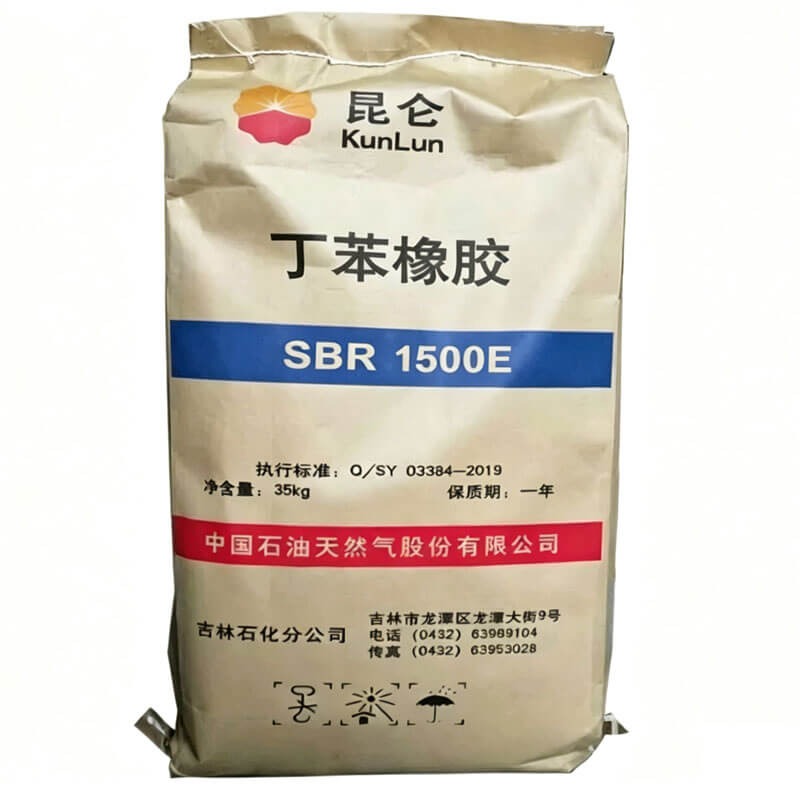
| HS Code | 223062 |
| Chemical Name | Styrene-Butadiene Rubber |
| Cas Number | 9003-55-8 |
| Appearance | White to light tan crumbs or bales |
| Mooney Viscosity Ml 1 4 At 100 C | 50-55 |
| Specific Gravity | 0.93-0.95 |
| Ash Content | ≤0.75% |
| Volatile Matter | ≤0.75% |
| Organic Acid Content | 5-7% |
| Soap Content | ≤0.05% |
| Bound Styrene Content | 23.5% |
| Tensile Strength | ≥25 MPa |
| Elongation At Break | ≥400% |
| Solubility | Soluble in aromatic, aliphatic, and chlorinated hydrocarbons; insoluble in water, alcohols, and ketones |
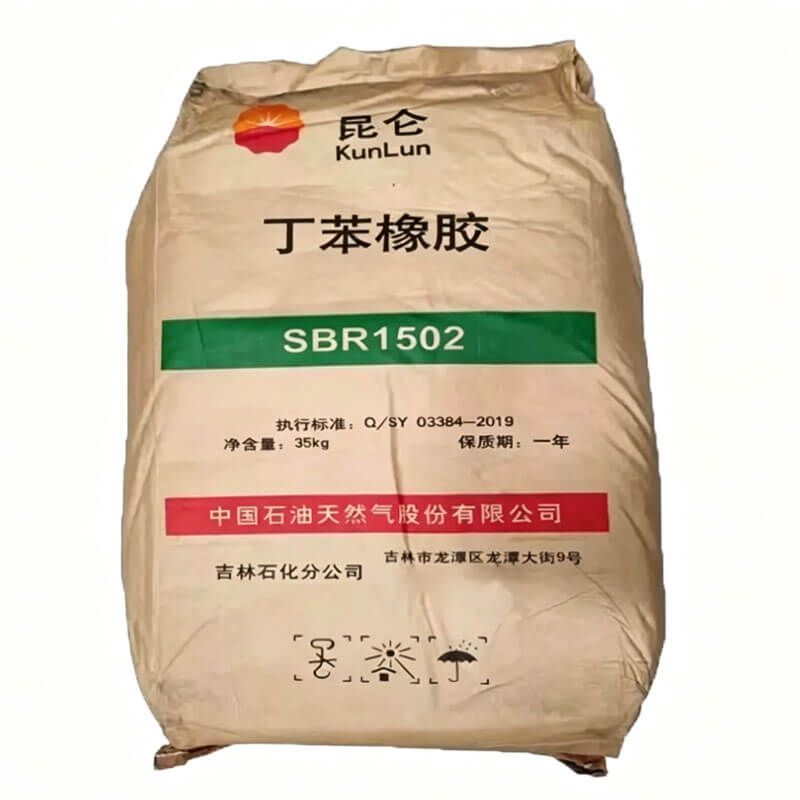
As an accredited Styrene‑Butadiene Rubber SBR 1502 factory, we enforce strict quality protocols—every batch undergoes rigorous testing to ensure consistent efficacy and safety standards.
| Packing | Styrene-Butadiene Rubber SBR 1502 is packaged in 25 kg polyethylene-lined kraft bags, palletized and shrink-wrapped for shipment. |
| Container Loading (20′ FCL) | Loaded as shrink-wrapped bales, stowed tightly in 20′ FCL containers, maximizing capacity to approximately 20 metric tons per shipment. |
| Shipping | Styrene‑Butadiene Rubber SBR 1502 ships as compressed bales, wrapped and palletized for efficient handling. It is transported in dry, ventilated containers or covered trucks to prevent moisture and contamination. Keep away from direct heat, oxidizers, and sunlight. Not regulated as hazardous material under normal conditions, but standard cargo securing applies. |
| Storage | Store SBR 1502 in a cool, dry, well-ventilated area away from direct sunlight, heat, and ignition sources. Keep bales on pallets off the floor to prevent moisture absorption and contamination. Avoid exposure to ozone, strong oxidizers, and UV light. Maintain moderate humidity and stable temperatures; use first-in, first-out rotation to maximize shelf life. |
| Shelf Life | SBR 1502 has a typical shelf life of 2 years when stored in cool, dry conditions, away from sunlight, ozone, and heat. |
In passenger car radial tire tread development, SBR 1502 is used as a non-oil-extended emulsion styrene-butadiene rubber with a nominal bound styrene content of 23.5% and a Mooney viscosity ML(1+4)100°C between 46 MU and 58 MU per ASTM D1646-19a. Tread compounds in volume production lines are mixed in either tangential or intermeshing internal mixers with net chamber volumes between 270 L and 420 L, following a two-stage cycle: first-stage masterbatch at rotor speeds of 35 rpm to 50 rpm and dump temperatures of 150°C to 170°C, followed by a second-stage finalization on a two-roll mill or internal mixer where sulfur and sulfenamide accelerators are added below 105°C to prevent scorch. The polymer addition ratio for a high-wear passenger tread is commonly 70 phr SBR 1502 with 30 phr high-cis polybutadiene, while retread strip compounds may use 60 phr SBR 1502 with 20 phr natural rubber and 20 phr polybutadiene. Carbon black N220/N330 is introduced at 60–85 phr, zinc oxide at 3–5 phr, stearic acid at 1–2 phr, antidegradant 6PPD at 2–3 phr, and sulfur/accelerator systems adjusted to an accelerator-to-sulfur ratio of 0.6 to 1.0. The vulcanization kinetics are quantified on a moving die rheometer at 160°C per ISO 6502:2016; for a retread strip compound the minimum torque ML is 1.5–2.5 dNm, maximum torque MH is 12–16 dNm, and t90 is 8–12 min. The extruded tread profile is then applied to the tire building drum, shaped, and cured at 150°C to 165°C under bladder pressures of 1.9 MPa to 2.4 MPa. Typical finished products are passenger car radial tires under ECE R30 and FMVSS 139 type approval, as well as precured retread strips bonded with cushion gum meeting ISO 4000-1:2010 dimensional requirements. A documented limitation is that SBR 1502 exhibits lower green strength than natural rubber measured by ASTM D6746-15, so retread cushion gum must be formulated with sufficient tackifier resin to prevent splice separation on the building drum.
Conveyor belt cover compounds produced with SBR 1502 are blended with natural rubber to raise tear resistance and with polybutadiene to improve low-temperature flexibility. In European mining belt manufacture, the polymer phase is often adjusted to 55 phr SBR 1502, 35 phr natural rubber RSS3, and 10 phr polybutadiene, with N220 or N234 carbon black at 45–60 phr, plasticizer at 5–10 phr, zinc oxide at 5 phr, stearic acid at 2 phr, and a sulfur cure system using 1.5–2.0 phr sulfur and 1.2–1.6 phr TBBS accelerator. The cover compound is mixed in a 270 L intermeshing internal mixer, dumped at 140°C to 155°C, then sheeted through a 610 mm two-roll mill and calendered onto polyester/nylon fabric or steel cord carcass at 0.6–1.2 mm cover thickness. Continuous vulcanization is carried out in a double-band rotocure at 150°C to 160°C for 25 min to 45 min depending on belt class, or in an autoclave for heavier steel cord belts. The finished covers for mining and aggregate belts are specified under ISO 14890:2013, DIN 22102-1:2014, and ASTM D378-13(2021); typical physical criteria include tensile strength not less than 20 MPa and elongation at break not less than 400% per ISO 37:2017, and abrasion loss not greater than 120 mm³ per ISO 4649:2017. A process failure observed on calender lines occurs when SBR 1502 is substituted above 70 phr without increasing plasticizer; the cover stock exhibits excessive shrinkage after calendering and can drag fabric edges out of alignment, leading to belt tracking defects in service. Incompatibility with high-aromatic process oils in the EU is controlled by REACH Annex XVII entry 50, restricting PAH content in extender oils used in tire and belt compounds.
| Component or property | System A: low NR | System B: medium NR | System C: high NR |
|---|---|---|---|
| SBR 1502 | 70 phr | 55 phr | 40 phr |
| Natural rubber RSS3 | 20 phr | 35 phr | 50 phr |
| High-cis polybutadiene | 10 phr | 10 phr | 10 phr |
| N220 carbon black | 55 phr | 50 phr | 45 phr |
| Aromatic process oil | 8 phr | 7 phr | 6 phr |
| Zinc oxide | 5 phr | 5 phr | 5 phr |
| Stearic acid | 2 phr | 2 phr | 2 phr |
| Sulfur | 1.5 phr | 1.8 phr | 2.0 phr |
| TBBS accelerator | 1.2 phr | 1.4 phr | 1.6 phr |
| Tensile strength target per ISO 37:2017 | ≥20 MPa | ≥20 MPa | ≥22 MPa |
| Elongation at break target per ISO 37:2017 | ≥400% | ≥400% | ≥400% |
| DIN abrasion target per ISO 4649:2017 | ≤120 mm³ | ≤120 mm³ | ≤120 mm³ |
In cold-feed injection of vulcanized soles, SBR 1502 compounds exhibit a narrow thermal processing window because the polymer’s non-oil-extended Mooney viscosity ML(1+4)100°C of 46–58 MU translates into higher shear heating in screw barrels compared with oil-extended SBR 1712. For vulcanized rubber soles, the formulation addition ratio is typically 50–70 phr SBR 1502, 30–50 phr natural rubber SMR20, and 0–15 phr solution styrene-butadiene or high-cis polybutadiene, with N330 carbon black at 40–60 phr, precipitated silica at 10–25 phr, process oil at 5–10 phr, zinc oxide at 4–5 phr, stearic acid at 1–2 phr, and a sulfur/sulfenamide cure system. Mixing is performed in a 75 L tangential internal mixer, with final sulfur addition on a two-roll mill at 80°C to 90°C roll temperature. Cure safety is monitored by Mooney scorch at 120°C per ASTM D1646-19a, with MS-t5 values above 18 min preferred for injection molding. Injection-molded soles are processed in screw-ram machines with barrel temperatures of 70°C to 90°C, mold temperatures of 150°C to 170°C, and injection pressures of 80 MPa to 110 MPa. Compression-molded sheet stock is preformed and cured in heated hydraulic presses at 150°C to 160°C for 6 min to 10 min per 3 mm thickness. Finished product types include vulcanized rubber outsoles for work boots, school shoes, and casual footwear, tested for abrasion resistance under ISO 20871:2018 with typical volume loss limits not exceeding 250 mm³, cut-growth resistance under ASTM D1052-09(2019) using a Ross flexing apparatus, and slip resistance under ISO 13287:2019. REACH compliance requires confirmation that process oils meet REACH Annex XVII restrictions on polycyclic aromatic hydrocarbons. A known limitation is that SBR 1502 has poor resistance to oils and solvents, so it is not specified for outsoles intended for oily workshop flooring; published comparative data for that configuration is limited and replacement with nitrile rubber is required at oil exposures above 5% volume swell per ISO 1817:2017.
Because solvent-borne contact cements require rapid dissolution and controlled open time, SBR 1502 is first broken down on a two-roll mill or in a high-shear mixer, then dissolved into a solvent blend of toluene, hexane, and methyl ethyl ketone. The polymer addition ratio in a sprayable contact adhesive is normally 12 wt% to 18 wt% SBR 1502 solids, with tackifier resin at 5–10 wt%, antioxidant at 0.2–0.5 wt%, and the balance solvent. For roller-applied panel cements the viscosity is adjusted to 3,000–6,000 mPa·s measured with a Brookfield viscometer at 20°C; spray grades are diluted to 300–800 mPa·s for cup gun application. Compliance is demonstrated under ASTM D816-06(2021) for bond separation and cold flow of rubber cements, and under REACH Annex XVII where solvent selection and migrated aromatic compounds are restricted. A production bottleneck occurs when residual moisture in the milled SBR sheet exceeds 0.3%; the dissolved cement becomes hazy and filter screens block with bound water. The finished adhesive is applied in automotive interior trim lamination, panel laminating, and mattress foam bonding, where open times of 10 min to 30 min and drying temperatures below 50°C are controlled to avoid auto-ignition of solvent vapors.
For steel mill bridle and coiler rolls, a grit-blasted steel core is coated with a bonding primer before SBR 1502 sheet is calendered onto the surface. The formulation addition ratio for a general-purpose roll cover is 60–80 phr SBR 1502, 20–40 phr natural rubber or high-cis polybutadiene, N330 carbon black at 50–70 phr, ester plasticizer at 5–15 phr, zinc oxide at 5 phr, stearic acid at 2 phr, sulfur at 2.0–2.5 phr, and sulfenamide accelerator at 1.2–1.8 phr. The uncured cover is wrapped with nylon release tape under 4–6 N/mm tension and vulcanized in an autoclave at 130°C to 150°C for 6 h to 12 h depending on cover wall thickness up to 25 mm. Acid-resistant rubber linings for pickling tanks use the same polymer addition ratio but with barium sulfate at 40–60 phr replacing part of the carbon black and with sulfonamide or peroxide cure to reduce ionic contamination. The finished rolls for steel mill bridle, coiler, and processing lines are ground to final surface roughness with Ra between 0.4 µm and 1.6 µm, and hardness is specified at 65–85 Shore A per ASTM D2240-15. Tensile properties are assessed under ASTM D412-16, abrasion resistance under ISO 4649:2017, rubber-to-metal adhesion under ASTM D429-14 method B with minimum peel values of 12 kN/m for steel mill roll covers, and chemical resistance under ASTM D471-16 with volume swell below 5% in 10% sulfuric acid at 23°C. A documented boundary is that SBR 1502 linings are not specified for strong oxidizing acids such as nitric acid above 10% concentration or for aromatic solvent storage; published performance data for those conditions is limited, and bromobutyl or ebonite linings are substituted.
Compression-molded industrial mats produced with SBR 1502 use high filler loadings to reduce compound cost and increase rigidity. A representative anti-fatigue mat compound contains 60–90 phr SBR 1502, 10–40 phr natural rubber, calcium carbonate at 50–100 phr, talc at 20–40 phr, process oil at 10–20 phr, zinc oxide at 5 phr, stearic acid at 2 phr, sulfur at 2.0–2.5 phr, and accelerator at 1.0–1.5 phr. Mixing is performed in a 110 L intermeshing internal mixer and sheeted on a two-roll mill before the stock is cut to blank size and cured in a multi-daylight hydraulic press at 150°C to 160°C under 10 MPa to 15 MPa specific pressure for 8 min to 12 min per 6 mm thickness. Sheet stock used for factory flooring is calendered at 2–6 mm thickness and vulcanized in a continuous rotocure. Finished product types include anti-fatigue mats, livestock mats, gym mats, and industrial floor tiles tested under ASTM F1344-15 for rubber floor tile dimensions and oil/chemical resistance, ASTM D412-16 for tensile properties, ASTM D624-00(2010) for tear resistance, and ISO 2781:2018 for density with typical values between 1.25 g/cm³ and 1.45 g/cm³. A process limitation is that high filler loadings above 150 phr total filler reduce mat tear strength below 12 kN/m and cause edge crumbling during demolding; production facilities therefore balance filler content against demolding integrity and drop-test impact resistance.
Competitive Styrene‑Butadiene Rubber SBR 1502 prices that fit your budget—flexible terms and customized quotes for every order.
For samples, pricing, or more information, please contact us at +8618136850665 or mail to sales4@ascent-chem.com.
We will respond to you as soon as possible.
Tel: +8618136850665
Email: sales4@ascent-chem.com
Flexible payment, competitive price, premium service - Inquire now!
Styrene-Butadiene Rubber SBR 1502 is a cold-polymerized, non-pigmented, non-staining general-purpose emulsion styrene-butadiene rubber. The grade is stabilized with a non-staining phenolic antioxidant rather than the staining amine-based stabilizers used in grades such as SBR 1500. Commercial specification limits for SBR 1502 typically set bound styrene at 22.5% to 24.5% by mass and Mooney viscosity ML(1+4)100°C at 46–56 MU when measured in accordance with ISO 2453:2020 and ASTM D1646-19. Volatile matter is controlled to ≤0.50% under ISO 248-1:2011, and ash is held to ≤0.20% under ISO 247-1:2018. Organic acid and soap residues are specified at 4.5–6.5% and ≤0.10% respectively by ISO 7781:2008. These limits reflect a polymer designed for consistent filler acceptance, reduced die swell, and light-colour stability in finished goods.
| Property | Typical specification range | Test method |
|---|---|---|
| Bound styrene | 22.5–24.5% by mass | ISO 2453:2020 |
| Mooney viscosity ML(1+4)100°C | 46–56 MU | ASTM D1646-19 |
| Volatile matter | ≤0.50% | ISO 248-1:2011 |
| Ash | ≤0.20% | ISO 247-1:2018 |
| Organic acid | 4.5–6.5% | ISO 7781:2008 |
| Soap | ≤0.10% | ISO 7781:2008 |
The bale form is typically packaged at 35 kg per bale and palletized at 1.05 t. Storage in ambient warehouses below 25°C limits antioxidant bloom and stabilizer migration. In high-humidity regions exceeding 60% RH, condensation on chilled bales transferred into warm mixing bays has been observed on production-scale docks; because volatile matter is below 0.50%, pre-drying is generally unnecessary. If surface condensation occurs, a dehumidified hold at 20–25°C for 24–48 h before feeding is required to prevent unstable ram positions in an internal mixer and non-uniform carbon black incorporation. The product is not considered hazardous under CLP, but dust from bale cutting should be controlled with local exhaust ventilation because fine rubber particles form combustible dust accumulations.
The primary differences are stabilizer type, emulsifier carryover, and resulting building tack. SBR 1500 is a staining grade stabilized with amine-type antioxidant and retains higher rosin acid residues, which produces darker colour and stronger green tack but limits use in white or pastel compounds. SBR 1502 uses a non-staining stabilizer and lower residual acid/soap levels, which improves colour retention after heat ageing but reduces autoadhesion. In multi-ply assembly such as tyre sidewall or conveyor belt splicing, processors often add 2–5 phr hydrocarbon tackifier to recover handling characteristics when substituting SBR 1502 for SBR 1500. Oil-extended SBR 1712 contains 37.5 phr process oil and exhibits lower raw-polymer Mooney viscosity, which makes it easier to mix at reduced shear energy. However, SBR 1712 yields lower tensile strength and hardness at equal filler loading because the oil acts as a softener. SBR 1502 remains the preferred grade when maximum physical properties and non-staining behaviour are required simultaneously in a dry-polymer form.
In tyre manufacturing, SBR 1502 is used in white sidewall and raised-white-letter compounds because the non-staining stabilizer resists development of brown surface discolouration caused by antiozonant migration from adjacent black compounds. For tread compounds, oil-extended SBR 1712 or solution SBR grades are often selected because SBR 1502 has lower filler loading capacity at equivalent mixer torque and higher energy demand during carbon black dispersion. In footwear, SBR 1502 is blended with 20–40 phr butadiene rubber to improve low-temperature flexibility and reversion resistance in vulcanized soles. Extruded hoses and calendered sheet use SBR 1502 where light colour and moderate oil resistance are acceptable; aromatic solvent resistance remains low because the polymer is non-polar.
On a 270 L production-scale internal mixer, SBR 1502 is charged after bales have been warmed above 15°C to avoid excessive initial rotor torque. A two-stage mix sequence is standard under ASTM D3182-16: first-stage dump at 150–160°C and second-stage finalization at 95–105°C with curatives. Fill factor is maintained at 0.75–0.80; higher fill factors reduce carbon black dispersion index and increase batch temperature variability. With 50 phr N339 carbon black and 5 phr naphthenic oil, compound Mooney viscosity ML(1+4)100°C typically reaches 65–75 MU, and dispersion index measured by reflected light microscopy exceeds 95% after 4 min of mixing at 40 rpm rotor speed. On a two-roll mill, roll temperature is controlled at 45–55°C for sheet-out; higher roll temperatures promote edge tackiness and may cause premature scorch in fast-accelerator formulations. Batch-to-batch Mooney variation of ±4 MU at incoming material can shift die swell in extruded profiles; closed-loop curative dosing and real-time profile dimension monitoring are applied when incoming Mooney is at specification extremes.
Filler loading capacity is influenced by bound styrene and molecular weight distribution. At carbon black loadings above 80 phr, SBR 1502 shows a steep increase in compound viscosity and a reduction in elongation at break; the processing window narrows to ±5°C on mill temperature because the compound becomes nervy and difficult to sheet. High-structure grades such as N339 are preferable at high loadings because dispersion energy is lower than with low-structure N660, but hysteresis and heat build-up are higher. Silica-filled SBR 1502 compounds require coupling agents and show higher compound viscosity than carbon black formulations at equal filler volume fraction; this is a critical processing threshold because torque-limited internal mixers may require a two-pass silica addition to prevent batch rejection.
In single-screw extruders with L/D ratios of 20:1 to 25:1 and compression ratios from 2.5:1 to 3.5:1, SBR 1502 compounds are processed with barrel zones set from 50°C at the feed throat to 80°C at the die. Die swell is higher for SBR 1502 than for oil-extended SBR 1712 at equivalent compound viscosity because the dry polymer has higher elastic recovery. Extrudate dimensions should therefore be checked at startup using a laser micrometer and adjusted through screw speed and die land length; die land lengths of 10–15 mm for profiles up to 20 mm cross-section are common. Calendered sheet gauge is controlled by roll temperature, nip gap, and rolling bank temperature; roll temperatures above 60°C may increase tack and cause film splitting. If amine-based antiozonants are excluded to preserve non-staining properties, paraffinic wax bloom can reduce surface friction and improve release, but loadings above 2 phr may reduce adhesion for lamination.
Cure behaviour of SBR 1502 in a conventional sulfur cure is governed by the balance between zinc oxide, stearic acid, sulfenamide accelerator, and free sulfur. Moving die rheometer data at 160°C per ASTM D5289-19 for a 50 phr N330-filled compound commonly show minimum torque near 1.8 dN·m, maximum torque in the 16–18 dN·m range, scorch time ts2 of 2.0–3.0 min, and tc90 of 8–12 min. These values shift substantially with accelerator type; a semi-efficient vulcanization system containing 1.2 phr sulfur, 1.0 phr N-cyclohexylbenzothiazole-2-sulfenamide, and 0.8 phr diphenylguanidine can produce tensile strength of 18–22 MPa and elongation at break of 400–550% when tested according to ISO 37:2017. Sulfenamide acceleration provides delayed action and improves processing safety, but addition of secondary accelerators such as tetramethylthiuram monosulfide at 0.1–0.3 phr reduces scorch time sharply. Compounds with sulfur-to-accelerator ratios below 1.0 generate higher monosulfidic crosslink density and better reversion resistance at 160–180°C, but cyclic fatigue and tensile strength are typically inferior to conventional sulfur systems. Zinc oxide levels below 3 phr reduce crosslink density and increase reversion in thick moulded sections; levels above 5 phr increase compound modulus but contribute to zinc-related bloom in non-staining formulations.
Direct replacement of SBR 1500 by SBR 1502 in a transfer or compression moulded product requires rebalancing green strength and tack. SBR 1502 compounds typically show lower autoadhesion and lower green strength at room temperature, which can cause pre-cure tearing in thick-section preforms during transfer moulding on presses with clamp forces below 150 t. The corrective approach is to add 5–10 phr precipitated silica or 3–5 phr hydrocarbon tackifier. Silica addition increases compound viscosity and improves tear resistance, but it requires a silane coupling agent at 8–10% of silica mass to maintain 300% modulus. Oven ageing at 120°C for 168 h under ISO 188:2011 generally demonstrates lower colour change for SBR 1502 than for SBR 1500 because the non-staining stabilizer does not form quinone-type chromophores. In injection moulding, screw plastication conditions should be adjusted: melt temperature at the nozzle is maintained between 90°C and 110°C, and mould temperature is set at 160–175°C for sulfur-cured compounds. Published data for this specific configuration is limited; production trials are required to confirm demoulding behaviour and mould fouling because non-staining stabilizers may migrate at lower rates than staining counterparts.
The raw polymer itself cannot confer finished-article compliance. Food-contact applications must be evaluated under FDA 21 CFR 177.2600 for rubber articles intended for repeated contact with food; extraction testing on the final compound is required because accelerators, antiozonants, and processing aids can migrate. Under EU REACH, SBR 1502 is supplied with a safety data sheet that identifies the registered monomer and antioxidant constituents; any extender oil or compounding ingredient added downstream must meet the PAH limits in REACH Annex XVII Entry 50. RoHS compliance under Directive 2011/65/EU Annex II is verified per batch for cadmium, lead, mercury, and hexavalent chromium; typical finished compounds are expected to fall below 100 mg/kg for each restricted metal but must be tested because carbon black and zinc oxide can contain trace metals. SBR 1502 should not be compounded with staining amine-based antioxidants such as N-phenyl-2-naphthylamine if non-staining performance is required, and exposure to ozone or strong oxidizing acids will cause surface cracking unless antiozonant waxes and substituted p-phenylenediamines are added at appropriate levels.
| Requirement | Designation | Application to SBR 1502 |
|---|---|---|
| Food-contact rubber articles | FDA 21 CFR 177.2600 | Raw polymer is not self-complying; finished compound extraction testing required |
| EU REACH registration | Regulation EC 1907/2006, Annex XVII | Monomer and stabilizer restrictions apply; supplier SDS required for downstream ingredient review |
| PAH in extender oils | REACH Annex XVII Entry 50 | SBR 1502 is dry polymer; downstream oil additions must meet limits |
| RoHS restricted substances | Directive 2011/65/EU Annex II | Batch verification for Cd, Pb, Hg, Cr(VI) |